In the third week of January 2026, the global financial system underwent a severe stress test precipitated by a singular, volatile geopolitical event: the escalation of United States policy regarding the acquisition of Greenland. What began as a reiteration of President Donald Trump’s long-standing interest in the Arctic territory rapidly metastasized into a transatlantic crisis, threatening the cohesion of NATO and bringing the European Union to the brink of a trade war. The crisis, ostensibly driven by the strategic necessity of the “Golden Dome” missile defense system and the race for rare earth minerals, served as a definitive referendum on the asset class of cryptocurrency.
For nearly a decade, the “Digital Gold” thesis—championed by institutional giants like BlackRock’s Larry Fink and corporate evangelists like MicroStrategy’s Michael Saylor—posited that Bitcoin would serve as a non-sovereign hedge against geopolitical instability. The events of January 2026 provided a stark counter-narrative. As the threat of tariffs and military unilateralism spiked the global fear index, capital fled not to the digital ether, but to the tangible safety of physical gold. While bullion surged to record highs near $4,900 per ounce, Bitcoin shed value in lockstep with risk assets, exposing deep-seated vulnerabilities in its market structure and challenging its status as a safe haven in times of acute state-level conflict.
This comprehensive report analyzes the “Greenland Crisis” through multiple lenses: the military-strategic drivers of the “Golden Dome”; the critical mineral economics of the Arctic; the diplomatic rupture between Washington, Brussels, and Ottawa; and, most crucially, the divergent behaviors of gold and Bitcoin. It argues that while the crisis was diffused by a “framework” deal in Davos, it has fundamentally altered the risk profile of digital assets in an era of “managed fragmentation” and coercive diplomacy.
The Anatomy of a Crisis
The crisis of 2026 did not emerge in a vacuum. It was the kinetic culmination of a policy ambition that had been dismissed as a “real estate fantasy” during President Trump’s first term in 2019. By January 2026, however, the geopolitical landscape had shifted. With the Arctic ice melting and opening new shipping lanes, and with Russia and China expanding their northern footprints, the acquisition of Greenland transitioned from a transactional desire to a perceived national security imperative for the United States.
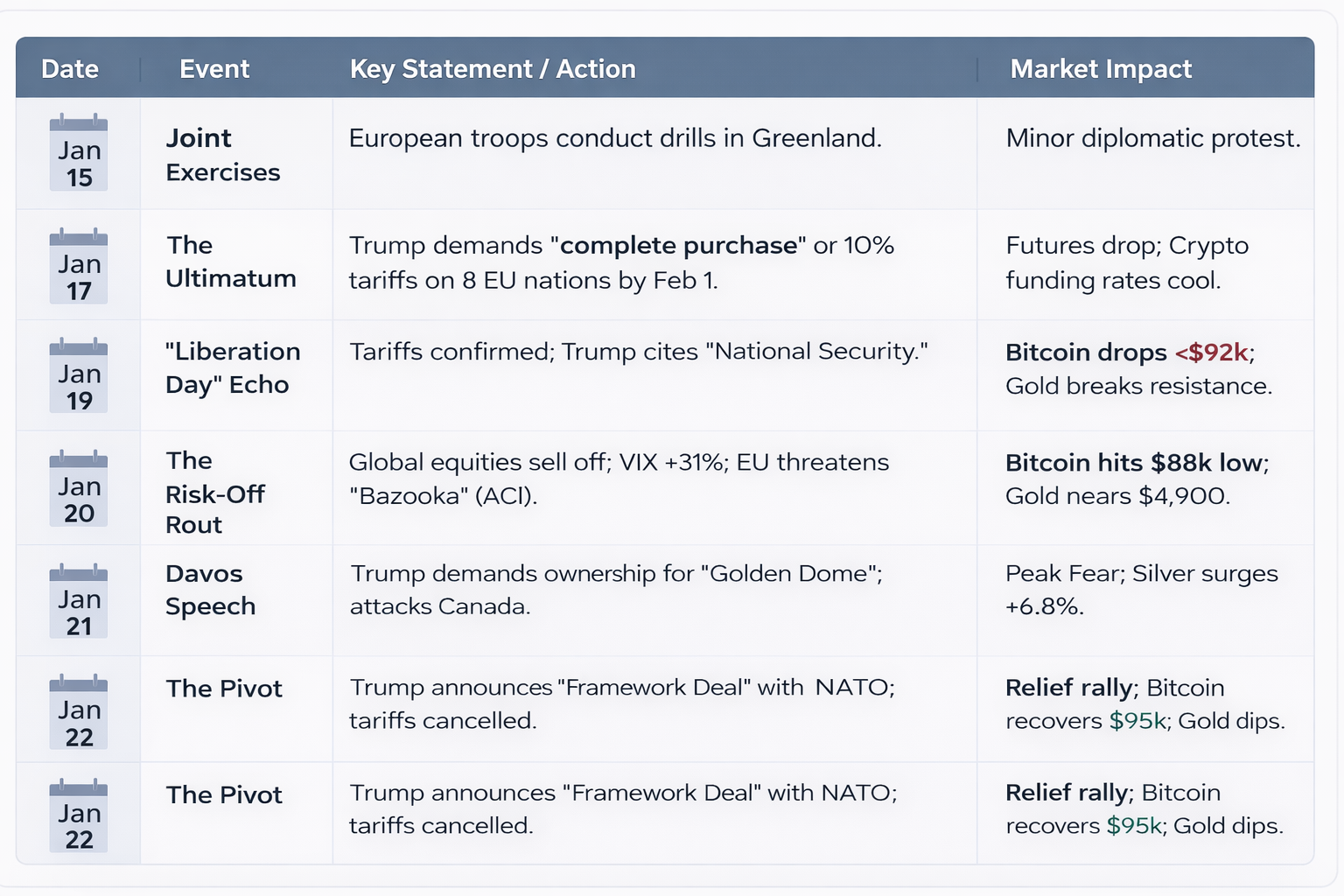
The escalation began in earnest following a joint military exercise in Greenland involving European nations. The Trump administration interpreted this deployment not as allied support, but as an encroachment on the Western Hemisphere’s security architecture. The response was swift and punitive. On Saturday, January 17, President Trump issued an ultimatum via Truth Social: unless Denmark negotiated the “complete and total purchase” of Greenland, the United States would impose a 10% tariff on all imports from eight specific European nations Denmark, Norway, Sweden, France, Germany, the United Kingdom, the Netherlands, and Finland effective February 1, 2026.
Crucially, the threat contained an embedded escalation clause: if no deal was reached by June 1, the tariffs would rise to 25%. This “maximum pressure” campaign, reminiscent of the “Liberation Day” tariffs of April 2025, was designed to bypass diplomatic norms and leverage America’s economic weight to force territorial concessions. The specificity of the target list—focusing on America’s closest NATO allies sent a chilling signal that Article 5 of the North Atlantic Treaty, which guarantees collective defense, might be conditional on property rights. As President Trump stated bluntly in Davos, “No one defends what they don’t own”.
The “Taco” Dynamic and Market Psychology
The market reaction was exacerbated by the unpredictability of the President’s negotiating style, a phenomenon European diplomats refer to as the “Taco” moment an acronym for “Trump Always Chickens Out.” This theory posits that the President ramps up threats to the brink of catastrophe to rattle markets and adversaries, only to withdraw them at the last minute in exchange for a face-saving “framework”.
However, financial markets in January 2026 could not afford to bet on a bluff. The Cboe Volatility Index (VIX), known as Wall Street’s “fear gauge,” surged 31% immediately following the tariff announcement. The threat of a 10-25% tariff on major European economies implied a massive liquidity shock to the global system, raising the specter of a recession just as the global economy was stabilizing.
Timeline of the Greenland Crisis Escalation (January 2026)
The European “Bazooka”: Anti-Coercion Instrument (ACI)
The severity of the market reaction was compounded by the European Union’s unprecedented willingness to retaliate. Unlike previous trade spats, the EU threatened to deploy its “Anti-Coercion Instrument” (ACI), often referred to as the “big bazooka”.
The ACI allows the EU to impose sweeping countermeasures against countries interfering in the sovereign choices of member states. In this instance, Brussels signaled it was prepared to target U.S. technology and cryptocurrency firms operating within the Single Market. This specific targeting of the digital sector introduced a regulatory risk premium to crypto assets that did not exist for physical commodities like gold or oil. The prospect of a transatlantic trade war involving data restrictions and service bans on U.S. tech giants added a layer of systemic risk that drove the correlation between Bitcoin and the Nasdaq 100 to uncomfortable heights.
The Strategic Imperative – The “Golden Dome”
To understand the market’s flight to safety, one must understand the stakes. The Greenland crisis was not merely about resource extraction; it was driven by the “Golden Dome,” a proposed $175 billion integrated air and missile defense system that became the centerpiece of the Trump administration’s second-term defense policy.
Technical Necessity of the Arctic
The strategic logic of the Golden Dome rests on the physics of nuclear deterrence. In the event of a conflict with Russia or China, Intercontinental Ballistic Missiles (ICBMs) would traverse the Arctic circle to reach targets in North America. Greenland sits directly beneath these trajectories, making it the “most valuable real estate on Earth” for early warning and interception.
While the U.S. already operates the Pituffik Space Base (formerly Thule) in northern Greenland, housing the AN/FPS-132 Upgraded Early Warning Radar, the Golden Dome architecture requires a denser, more invasive footprint.
Hypersonic Defense: Defending against Hypersonic Glide Vehicles (HGVs) like Russia’s Oreshnik requires detection the moment the weapon breaks the radar horizon. Ground-based radars in the continental U.S. are limited by the curvature of the Earth. A sensor network in Greenland extends the “battle space,” allowing for mid-course interception before the warhead can maneuver unpredictably in the lower atmosphere.
Sovereignty vs. Security: The Trump administration argued that such a critical system could not be “outsourced” to a foreign power, even an ally like Denmark. “You cannot defend what you do not own,” became the refrain, implying that the U.S. needed sovereign control over the land to guarantee the operational security of the missile shield.
Golden Dome vs. Iron Dome
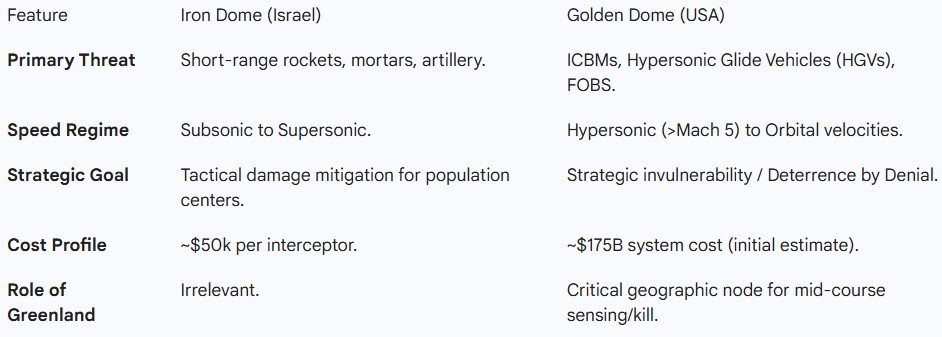
Media reports often conflated the proposed Golden Dome with Israel’s Iron Dome, but the systems are fundamentally different in scope and technology.
Comparative Analysis of Missile Defense Systems
Critics, including former military officers, labeled the project a “fantasy,” citing the immense difficulty of intercepting maneuvering hypersonic vehicles. However, the administration’s commitment to the project and the willingness to risk a trade war for it—signaled to markets that the U.S. was pivoting to a “Fortress America” stance, further isolating itself from multilateral alliances.
The Canadian Complication
The Golden Dome also strained relations with Canada. While President Trump asserted the system would “defend Canada,” Prime Minister Mark Carney (who, in this 2026 timeline, leads the Canadian government) firmly rejected the initiative. Carney, emphasizing Canadian sovereignty, refused to join the U.S. “Board of Peace” and aligned Ottawa with the European position on Greenland. This friction on the northern border added another layer of geopolitical risk, as Canada is a key trading partner and integrated member of the North American aerospace defense command (NORAD). The specter of a fractured North American security perimeter contributed to the “risk-off” sentiment that punished Canadian assets and the CAD, further driving the “debasement” narrative for fiat currencies.
The Resource War Rare Earths and Sovereignty
Beneath the ice and the missile defense rhetoric lay a colder economic reality: the war for critical minerals. Greenland holds some of the world’s largest undeveloped deposits of Rare Earth Elements (REEs), materials vital for everything from F-35 fighter jets to electric vehicle motors.
Breaking the Chinese Monopoly
The U.S. Geological Survey estimates that Greenland’s deposits could theoretically break the West’s dependence on China, which controls the vast majority of global rare earth processing. Two primary projects became flashpoints in the crisis:
Tanbreez Mining Project: Located in Southern Greenland, this project is rich in heavy rare earths like dysprosium and terbium. It was acquired by Critical Metals Corp (Nasdaq: CRML), a New York-based firm. The company actively courted U.S. government support, receiving interest from the Export-Import Bank for funding. The crisis caused immense volatility for CRML stock, as investors weighed the potential for U.S. backing against the risk of Danish regulatory backlash.
Kvanefjeld Project: A massive deposit plagued by political controversy due to its uranium content. Historically linked to Chinese investors, this site represents the “nightmare scenario” for Washington: a Chinese strategic foothold in the Arctic. The U.S. push for sovereignty was, in part, a preemptive move to deny Beijing access to these resources.
The Market Impact on Miners
The crisis created a bifurcation in mining stocks. While junior miners with exposure to Greenland faced uncertainty, established players and AI-driven mining firms saw increased interest from billionaires seeking to capitalize on the “securitization” of the Arctic. Amaroq Minerals, operating the Nalunaq gold mine, became a bellwether for investor sentiment regarding Greenlandic stability. The company’s ability to maintain production and liquidity during the crisis suggested that, regardless of the flag flying over Nuuk, the resources would eventually flow.
The Asset Class Divergence – Gold vs. Bitcoin
The most significant financial takeaway from the Greenland Crisis was the decoupling of Bitcoin from Gold. For years, the crypto industry has marketed Bitcoin as “Digital Gold” a superior, portable, non-sovereign store of value. The events of January 2026 provided a live-fire test of this thesis, and the results were unambiguous.
Real Gold: The Anti-Fragile Hedge
As the crisis deepened, gold behaved exactly as a safe-haven asset should.
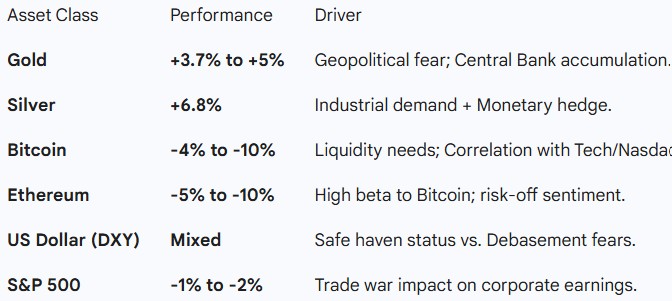
Price Action: Spot gold shattered resistance levels, surging from around $4,600 to nearly $4,900 per ounce.
Drivers: The rally was fueled not just by the fear of war, but by the structural fear of fiat debasement. Central banks in China, Russia, and India continued their relentless accumulation of bullion, diversifying away from a weaponized U.S. dollar.
Silver’s Beta: Silver acted as a high-beta proxy for gold, soaring 6.8% to trade past $94 per ounce. Its dual role as a monetary and industrial metal made it attractive to investors hedging against both currency failure and supply chain disruptions.
Digital Gold: The Risk-On Trap
Conversely, Bitcoin failed to capture the safe-haven bid.
Price Collapse: From a high near $98,000, Bitcoin plummeted to sub-$90,000 levels, touching lows of $88,850 during the peak of the tariff scare.
Liquidation Cascade: The sell-off was exacerbated by the liquidation of over $1 billion in leveraged long positions within 24 hours. Because crypto markets operate 24/7, they became the venue of first resort for liquidity, forcing traders to sell Bitcoin to cover margin calls in traditional asset classes
The Trapdoor Ratio: Technical analysts noted a breakdown in the Gold-to-Bitcoin ratio. The ratio entered a “trapdoor” zone, with Bitcoin hitting a two-year low against gold on a liquidity-adjusted basis. This signaled a profound rotation of capital: when the “fear trade” is purely geopolitical (war/tariffs) rather than purely monetary (money printing), capital prefers physical finality over digital scarcity.
Asset Performance During the Crisis Peak (Jan 19-21, 2026)
Why Did “Digital Gold” Fail?
The breakdown of the digital gold narrative can be attributed to four key factors exposed by the crisis:
Correlation with Risk: Institutional investors still treat Bitcoin as a high-growth tech stock. When the Nasdaq falls due to trade war fears, Bitcoin falls with it.
Regulatory Threat: The specific threat of the EU’s “Anti-Coercion Instrument” targeting U.S. crypto firms created a regulatory headwind unique to the sector.
Liquidity Preference: In a “margin call” scenario, investors sell what is liquid and profitable. Bitcoin, having had a strong run prior to the crisis, was a prime candidate for profit-taking.
Larry Fink’s Pivot: BlackRock CEO Larry Fink had previously championed Bitcoin as “Digital Gold.” However, the crisis revealed a nuance in institutional thinking: Bitcoin is a hedge against long-term monetary debasement, but gold is the hedge against immediate geopolitical chaos.
The Corporate & Ideological Stakes
While the price action was bearish, the crisis galvanized the ideological core of the cryptocurrency movement. The standoff over Greenland was viewed by crypto-natives not as a failure of Bitcoin, but as a validation of the need for “Network States” and non-sovereign money.
MicroStrategy’s Billion-Dollar Bet
Amid the plummeting prices, MicroStrategy, led by Executive Chairman Michael Saylor, doubled down. The company announced the acquisition of an additional 22,305 BTC for approximately $2.13 billion at an average price of $95,284. This massive buy-wall demonstrated that corporate treasuries committed to the Bitcoin standard are price-agnostic in the face of geopolitical noise. Saylor’s public comment during the rout “Thinking about buying more Bitcoin” reinforced the maximalist view: that volatility is the price of admission for an asset that sits outside the traditional banking system. For MicroStrategy, the Greenland crisis was a temporary liquidity event in a decades-long “debasement super-cycle”.
The “Network State” and Praxis
The crisis also reignited interest in the concept of the “Network State”—the idea that online communities can crowdfund territory and gain diplomatic recognition. Balaji Srinivasan, a prominent investor and theorist, has long cited Greenland as a potential candidate for such a project. During the crisis, Praxis, a project aiming to build a crypto-native city, reportedly made a symbolic “bid” to buy Greenland, mirroring the U.S. approach but based on voluntary association rather than military coercion. While dismissed by mainstream diplomats, this development highlighted a growing trend: as nation-states like the U.S. treat territory as a transactional asset, non-state actors are increasingly emboldened to enter the geopolitical arena, using crypto-capital as their leverage.
The Resolution A “Framework” for De-escalation
The tension broke on Wednesday, January 21, during the World Economic Forum in Davos. In a move characteristic of his negotiating style, President Trump announced a “framework of a future deal” with NATO Secretary General Mark Rutte, effectively de-escalating the immediate threat.
The Davos Pivot
Trump withdrew the threat of tariffs and explicitly ruled out the use of force, stating, “I won’t use force. All the United States is asking for is a place called Greenland”. The announcement triggered a massive relief rally across risk assets. Bitcoin rebounded to $95,000, recovering its losses as the “fear premium” evaporated.
The Anatomy of the Deal
The details of the “framework” remain contested, reflecting the “Taco” dynamic of ambiguous resolution.
The U.S. View: The White House claimed the deal secured “total access” for the military and the Golden Dome, with unnamed officials suggesting sovereignty over “small pockets” of land similar to the U.S. base at Guantanamo Bay or UK bases in Cyprus.
The Danish View: Prime Minister Frederiksen and Greenlandic officials insisted that sovereignty was never on the table. They characterized the deal as a recommitment to the existing 1951 defense treaty, with perhaps an enhanced NATO presence to monitor the Arctic, but absolutely no cession of territory.
The NATO Role: Mark Rutte acted as the crucial intermediary, allowing Trump to claim a win (security access) while preserving the territorial integrity of a member state. Rutte confirmed that the issue of “sovereignty” did not come up in the final talks, focusing instead on “Arctic security”.
Future Outlook: Managed Fragmentation
The Greenland Crisis of 2026 may have ended without a trade war, but it has fundamentally altered the investment landscape. The world is moving toward “Managed Fragmentation”, where economic blocs use coercion to secure resources and security architectures.
The Debasement Trade: The fiscal cost of the Golden Dome ($175B+) and the continued militarization of trade suggest that the U.S. dollar will face long-term pressure. In this environment, analysts predict that Gold and Bitcoin will eventually re-correlate to the upside. If the U.S. resorts to printing money to fund its Arctic ambitions, the “debasement trade” will lift all hard assets.
Asset Allocation: For investors, the lesson is clear. Gold remains the primary insurance policy against immediate geopolitical ruptures. Bitcoin remains a leveraged bet on long-term monetary debasement and technological adoption. The crisis proved that they are not interchangeable; rather, they are complementary components of a portfolio designed to survive the volatile transition to a multipolar world order.
As the dust settles over Nuuk and Davos, the question remains: if a “framework” can be conjured to save the markets today, what happens when the next red line be it in the South China Sea or the Arctic ice—is crossed not with tariffs, but with kinetic force? In that scenario, the divergence between digital and real gold may narrow, as the utility of any asset depends on the survival of the network that sustains it.