
Is OKX Safe in 2026? Regulation, Security & Risk Breakdown
OKX crypto exchange security infographic showing proof of reserves, 95% cold storage, $700M risk shield fund, and global regulatory licenses in 2026As we all know, the global financial landscape of...


OKX crypto exchange security infographic showing proof of reserves, 95% cold storage, $700M risk shield fund, and global regulatory licenses in 2026As we all know, the global financial landscape of January 2026 stands at a critical crossroads, marked by the definitive end of the “Wild West” era of cryptocurrencies and the emergence of a highly regulated, technologically empowered ecosystem. At the heart of this transformation is OKX, which evolved from its controversial OKEx origins to become arguably the world’s most transparent and cryptographically verifiable trading platform today. The question of whether OKX, the second-largest exchange by trading volume and serving 50 million users worldwide, is “secure” is no longer a local concern for retail investors, but a systemic inquiry for the entire digital asset industry. In this report, we offer a comprehensive audit of the platform’s security profile, addressing the complexities of its $30.6 billion in reserves, multi-jurisdiction regulatory network, and the architectural changes defining its “Kinetic Finance” vision for the late 2020s.
Table Of Content
- The Evolution of Trust: From Offshore Ambiguity to Cryptographic Verifiability
- The Global Regulatory Web: Navigating the MiCA, VARA, and MAS Frameworks
- The European Union and the MiCA Paradigm
- The Middle East: Dubai’s VARA Oversight
- Asia-Pacific: Singapore and the MAS Shield
- The $505 Million Reconciliation: Analyzing the 2025 US Settlement
- Security Engineering: The Multi-Layered Defense of 2026
- Custody Ratios and Cold Storage
- Multi-Signature and MPC Technology
- The $700 Million Risk Shield: The Ultimate Safety Net
- The Kinetic Finance Era: AI Agents and RWA Tokenization
- The AI Transaction Revolution
- RWA 2.0 and Deep Financialization
- Comparative Risk Analysis: OKX vs. Binance vs. Coinbase
- OKX vs. Binance
- OKX vs. Coinbase
- The Human Element: Social Engineering and the Phishing Threat
- Market Dynamics and Systemic Risks in 2026
- Is Your Capital Safe on OKX?
- Summary of Safety Metrics (January 2026)
The Evolution of Trust: From Offshore Ambiguity to Cryptographic Verifiability
The narrative of OKX’s safety in 2026 is fundamentally a story of a platform that recognized the unsustainability of the offshore model before the market forced its hand. Following the seismic collapse of rival exchanges in previous years, OKX embarked on a multi-year mission to replace corporate promises with mathematical proof. The cornerstone of this effort is the platform’s Proof of Reserves (PoR) program, which, as of January 2026, has released its 39th consecutive monthly report. This is not merely a marketing exercise; it is a sophisticated implementation of Zero-Knowledge Scalable Transparent Argument of Knowledge (zk-STARK) technology and Merkle Tree structures that allow for a level of transparency previously thought impossible in centralized finance.
The technical mechanism of the zk-STARK integration is a marvel of modern cryptography. By taking a comprehensive snapshot of every user’s asset balance and feeding this data into a tamper-proof, encrypted Merkle tree system, OKX creates a “trace table” that proves the existence of assets without revealing sensitive user data or specific wallet addresses to the public. This ensures that the exchange is not “paper trading” or operating on a fractional reserve basis. For the user in 2026, this means that every single satoshi, wei, or wei-equivalent of USDT is backed 1:1 by physical assets held in the exchange’s custody. The data from the most recent audit confirms that OKX’s primary assets are significantly overcollateralized, providing a buffer against the extreme liquidity shocks that often characterize the crypto markets.
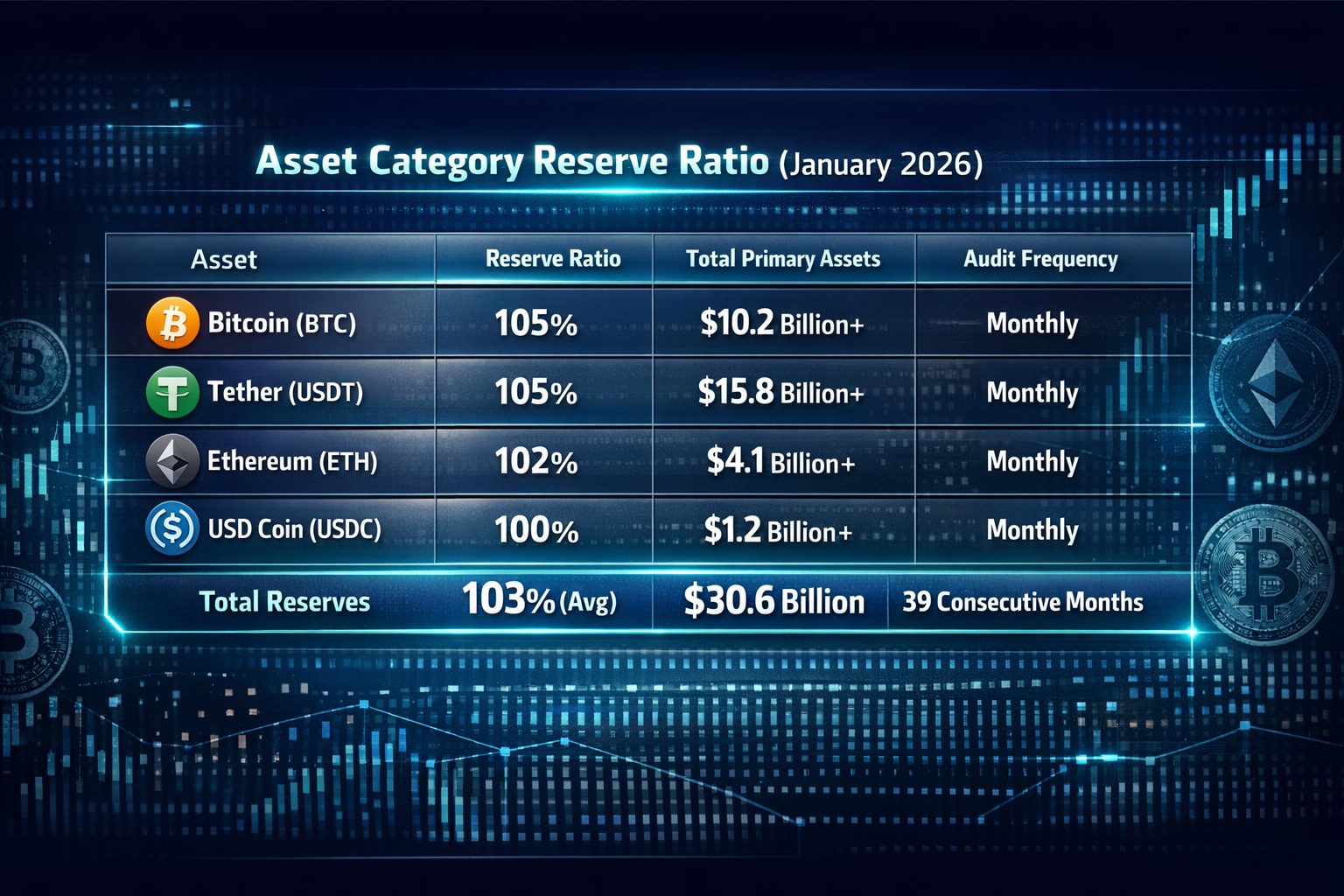
The implications of this 105% reserve ratio for BTC and USDT are profound. In a scenario of a “bank run,” where a massive percentage of users attempt to withdraw their funds simultaneously, OKX mathematically demonstrates that it holds more than enough capital to satisfy every withdrawal request. This level of solvency verification, audited independently by blockchain security firms like Hacken, serves as the primary firewall between OKX and the contagion risks that have historically plagued the sector.
The Global Regulatory Web: Navigating the MiCA, VARA, and MAS Frameworks
While cryptographic proof provides technical safety, regulatory compliance provides legal safety. OKX’s strategy in 2026 is one of aggressive localization, moving away from a singular global entity toward a constellation of licensed regional hubs. This fragmented approach is designed to ensure that the platform can survive even if a specific jurisdiction takes a hostile stance toward digital assets.
The European Union and the MiCA Paradigm
In Europe, OKX has positioned itself as a pioneer of the Markets in Crypto-Assets (MiCA) regulation. By selecting Malta as its primary hub, OKX leverages its local entity, Okcoin Europe Ltd, which holds a Class 4 Virtual Financial Assets (VFA) Service Provider license. Under the MiCA framework, which is fully matured by 2026, this license provides “passporting” rights across the entire European Economic Area (EEA), allowing OKX to offer regulated services to over 400 million citizens. This compliance is not just about a badge; it mandates rigorous standards for IT security, governance, and the safeguarding of client assets, effectively placing OKX on a par with traditional European financial institutions in terms of operational oversight.
The Middle East: Dubai’s VARA Oversight
The Middle East represents a strategic nexus for OKX’s institutional growth. OKX Middle East Fintech FZE operates under the full oversight of the Dubai Virtual Assets Regulatory Authority (VARA). The platform has successfully transitioned from a Minimal Viable Product (MVP) preparatory phase to a full Virtual Asset Service Provider (VASP) license. This license is particularly significant because it explicitly authorizes OKX to provide exchange services, lending and borrowing, and broker-dealer services to both retail and institutional clients within the Emirate. The VARA regime is known for its “compliance by design” approach, requiring exchanges to maintain strict custody standards that mitigate cybersecurity risks and enhance user protection.
Asia-Pacific: Singapore and the MAS Shield
Singapore remains the jewel in the crown of OKX’s Asian operations. OKX SG has secured a full Major Payment Institution (MPI) license from the Monetary Authority of Singapore (MAS), one of the most respected financial regulators globally. The appointment of Gracie Lin, a former MAS official, as CEO of the Singapore entity highlights the platform’s “insider-led” compliance strategy. This license allows OKX to offer digital payment token services and cross-border transfers under a regime that is notoriously difficult to satisfy, requiring deep capital reserves and exhaustive Anti-Money Laundering (AML) controls.

The withdrawal of OKX’s license application in Hong Kong in 2024 was a calculated move that signaled a shift in strategy. Rather than adhering to the increasingly restrictive and localized requirements of the SFC, OKX chose to focus on the broader international markets where its “offshore-but-regulated” model could thrive with greater efficiency. This illustrates a nuanced understanding of regulatory risk: safety is not just about having every possible license, but about having the right licenses in jurisdictions that offer a sustainable and clear legal runway.
The $505 Million Reconciliation: Analyzing the 2025 US Settlement
No investigation into OKX’s safety in 2026 would be complete without addressing the elephant in the room: the $505 million settlement with United States regulators in early 2025. This settlement stemmed from an investigation into historic AML breaches and the operations of Aux Cayes FinTech, an OKX affiliate that had failed to register as a money transmitter while serving US-based clients.
While a fine of half a billion dollars is staggering, the context of the settlement is arguably positive for the platform’s long-term stability. The resolution contained no charges of actual money laundering, focusing instead on the procedural failure to obtain a license. In the “Trump-era enforcement” landscape of 2025-2026, this settlement served as a “clearing of the decks,” allowing OKX to resolve its legacy legal issues and move forward with a clean slate. For institutional investors, a settled entity is a safe entity. The removal of the threat of a looming DOJ or SEC action has opened the doors for OKX to engage in deeper partnerships with traditional financial players, such as its institutional trading pilot with Standard Chartered in Dubai.
Security Engineering: The Multi-Layered Defense of 2026
Beyond the legal and cryptographic frameworks, the day-to-day safety of OKX is ensured by a massive investment in physical and digital security infrastructure. In 2026, OKX’s custody model is designed to be resilient against both external state-sponsored actors and internal points of failure.
Custody Ratios and Cold Storage
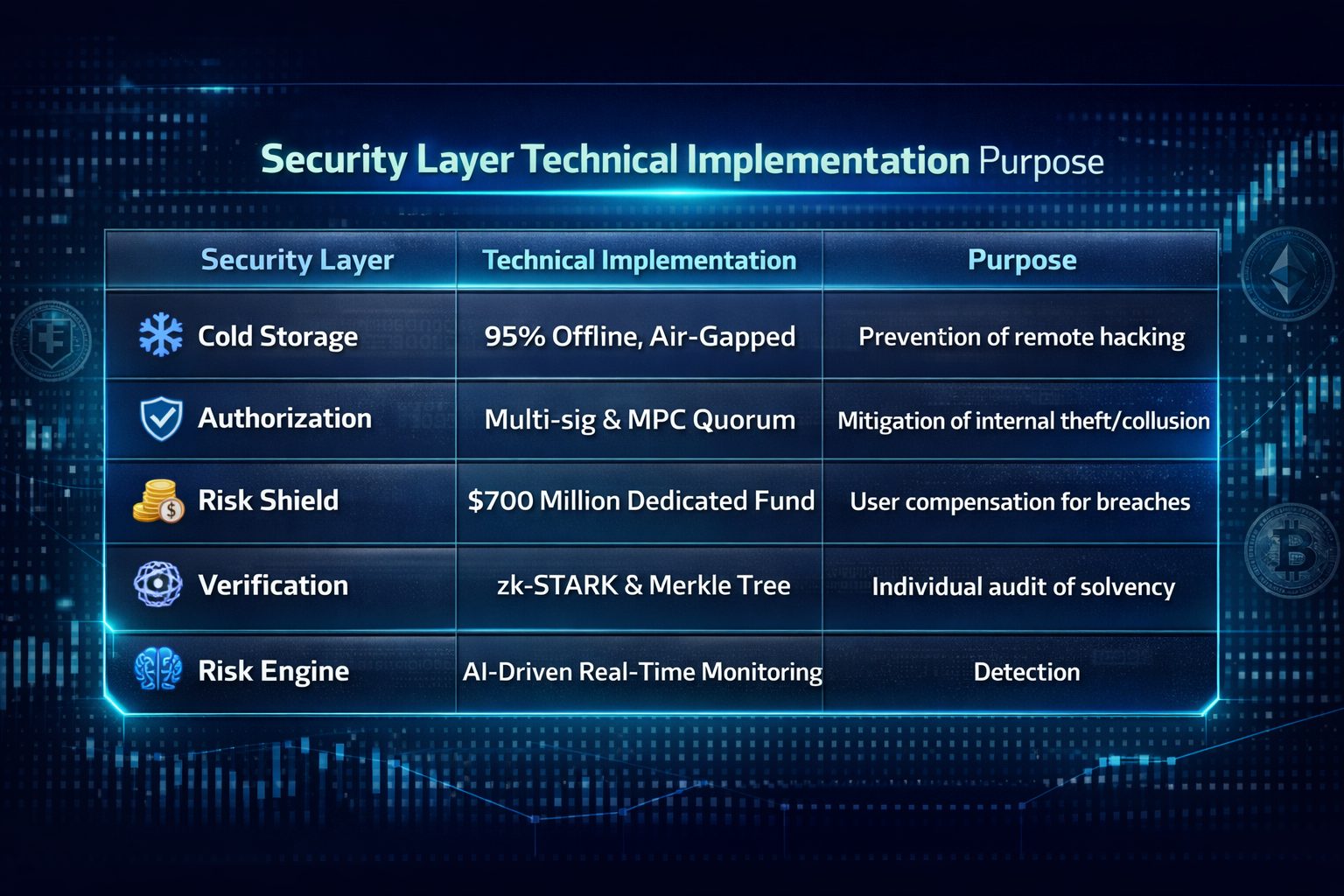
The platform adheres to a strict 95/5 custody split. Approximately 95% of all user assets are held in “cold storage”—offline, air-gapped wallets that are physically isolated from the internet. These cold wallets are distributed across multiple geographic locations to mitigate the risk of a localized disaster or physical breach. The remaining 5% of assets are kept in “hot wallets” to provide the liquidity necessary for the millions of daily withdrawals that occur on the platform.
Multi-Signature and MPC Technology
Access to these funds is protected by a sophisticated multi-signature (multi-sig) and Multi-Party Computation (MPC) authorization process. No single individual at OKX—not even the CEO—has the authority or the technical ability to move funds from cold storage unilaterally. Transactions require a quorum of high-level security officers, each holding a fragment of the necessary keys, ensuring that internal collusion is mathematically improbable.
The $700 Million Risk Shield: The Ultimate Safety Net
Perhaps the most tangible layer of protection for the average user is the “OKX Risk Shield,” which in 2026 is valued at over $700 million. This is a dedicated emergency reserve fund, similar in concept to Binance’s SAFU, designed to compensate users in the event of an extraordinary security breach or platform failure. What makes the Risk Shield unique is its funding mechanism: OKX allocates a percentage of its quarterly trading fees directly into this fund, ensuring that the “safety net” grows in proportion to the exchange’s total assets under management.
The Kinetic Finance Era: AI Agents and RWA Tokenization
As we navigate 2026, OKX is not just securing assets; it is redefining the very nature of financial transactions through its “Kinetic Finance” initiative. This vision, articulated by OKX Ventures, predicts a world where the primary actors in trading are no longer humans, but AI agents capable of executing complex strategies at millisecond speeds.
The AI Transaction Revolution
By the end of 2026, it is projected that over 45% of all on-chain transactions will be initiated by non-human actors. This shift necessitates a revolution in security. Traditional human-review KYC/AML is far too slow to monitor AI agents. Consequently, OKX has implemented “millisecond-level automated risk control” at the code level. This means that the exchange’s security protocols are built directly into the smart contracts and settlement layers, identifying and blocking malicious activity before it can propagate through the network.
RWA 2.0 and Deep Financialization
Another pillar of OKX’s 2026 safety is the tokenization of Real-World Assets (RWAs). The platform predicts that non-stablecoin RWAs—such as tokenized US Treasuries, real estate, and intellectual property—will exceed $100 billion in scale by the end of the year. For the user, this means that the collateral backing their positions on OKX is increasingly diversified away from volatile “crypto-native” assets into traditionally stable, yield-bearing financial instruments. The transition from T+2 to T+0 (instant) settlement for these assets drastically reduces counterparty risk, as the asset and the payment are exchanged simultaneously on-chain.
Comparative Risk Analysis: OKX vs. Binance vs. Coinbase
To provide a truly nuanced understanding of OKX’s safety, one must compare it against the other “Great Powers” of the 2026 exchange landscape.
OKX vs. Binance
Binance remains the largest exchange, with a $1 billion SAFU fund that slightly outscales OKX’s $700 million Risk Shield. However, OKX has taken a more aggressive stance on cryptographic transparency. While Binance provides periodic Proof of Reserves, OKX’s 39-month streak of monthly zk-STARK audits is considered the industry’s gold standard for “verifiable solvency”. For users who value mathematical proof over corporate size, OKX is often perceived as the safer choice in 2026.
OKX vs. Coinbase
Coinbase remains the preferred choice for US-based retail investors due to its status as a publicly traded company on the NASDAQ and its strict adherence to SEC and FINRA oversight. However, Coinbase’s “safety” is primarily legal and administrative. In terms of “Web3 safety”—the ability to verify one’s own assets on-chain and participate in decentralized ecosystems while maintaining custodial protections—OKX’s infrastructure is significantly more advanced. Furthermore, OKX’s competitive fee structure and its leadership in the tokenized RWA market make it a more viable platform for the active, global trader of 2026.
The Human Element: Social Engineering and the Phishing Threat
Despite the billion-dollar security funds and the zero-knowledge proofs, the greatest risk to OKX users in 2026 remains the “Human Element.” OKX has been a prime target for sophisticated phishing and social engineering attacks. In 2024, a series of breaches occurred where hackers used “forged court documents” to trick platform representatives into releasing personal information of a limited number of users.
These incidents underscore that safety is a shared responsibility. While the “vault” of OKX is virtually impregnable, the “gateways”—the individual user accounts—are only as secure as the user’s own practices. To mitigate this, OKX has made several security features mandatory for all users in 2026:
- Mandatory Two-Factor Authentication (2FA): Support for SMS 2FA has been deprecated in favor of hardware security keys and app-based authenticators.
- Withdrawal Address Allowlisting: A 24-hour “cooling off” period is enforced whenever a new withdrawal address is added, preventing hackers from instantly draining an account after a successful phishing attempt.
- Anti-Phishing Codes: Every official email from OKX contains a user-defined code, ensuring that the recipient can verify the authenticity of the communication.
- AI-Driven Behavioral Analysis: The OKX risk engine monitors for unusual login patterns, such as an IP address from a new country attempting a large withdrawal immediately after a password change, and automatically triggers a manual security review.
Market Dynamics and Systemic Risks in 2026
Safety is also a function of market stability. The 2026 crypto market is characterized by a “flight to quality,” where liquidity is concentrating in the top three exchanges. This concentration creates a systemic risk: if OKX were to fail, the impact on the global economy would be significant. However, the maturation of the “Basis Trade” has created a stabilizing effect on the platform’s liquidity.
The basis trade exploiting the price difference between spot and futures has become a mainstream institutional strategy, often offering yields between 8% and 12%. The math behind this is essential for understanding OKX’s liquidity safety:
{Basis} = {Futures Price} – {Spot Price}
Institutions take a delta-neutral position, buying spot assets and shorting futures simultaneously. This creates a massive, stable pool of liquidity on both sides of the order book, making it much harder for “whale trades” to manipulate prices or cause flash crashes that could trigger cascading liquidations.
Is Your Capital Safe on OKX?
As of 2026, OKX has successfully transformed itself from a high-risk derivatives platform into a pillar of global financial infrastructure. Its safety is built on three distinct but interconnected pillars:
- Cryptographic Pillar: The $30.6 billion zk-STARK Proof of Reserves ensures that every cent of user capital is present and accounted for.
- Regulatory Pillar: Licenses from MiCA, VARA, and MAS provide a legal protective shell and subject the exchange to rigorous external audits.
- Capital Pillar: The $700 million Risk Shield and 95% cold storage ratio provide a physical and financial buffer against the inevitable threats of the digital age.
For the institutional investor, OKX offers a compliant, high-liquidity gateway into the “Kinetic Finance” of the future. For the retail trader, it provides a user-friendly platform backed by some of the most advanced security engineering in existence. While no platform can ever be 100% “safe” in a world of nation-state hackers and evolving cyber-threats, OKX in 2026 represents the current pinnacle of what a secure, transparent, and regulated exchange can be.
The 2025 settlement with US authorities, rather than being a mark of shame, served as the final “stress test” that OKX needed to pass to achieve global legitimacy. By paying its dues and overhaulding its compliance systems, OKX has emerged as a resilient, battle-tested titan. In the 2026 landscape of digital assets, OKX is not just a place to trade; it is a fortress for the modern investor’s capital.
Summary of Safety Metrics (January 2026)
Solvency: Verified 1:1 backing for 39 consecutive months.
Liquidity: Over $30 billion in primary assets.
Insurance: $700 million Risk Shield reserve fund.
Custody: 95% of assets in offline cold storage.
Regulatory Status: Fully licensed in EU, Singapore, and Dubai.
Security Audit: “AA” rating from CertiK and regular audits by Hacken.
The evidence indicates that OKX is among the safest platforms for managing digital wealth in 2026, provided that users utilize the full suite of account-level security features provided by the exchange.