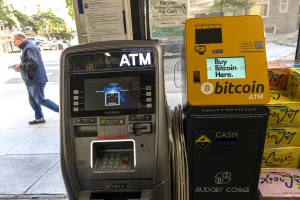
The global financial ecosystem of 2026 represents a seminal convergence between legacy credit networks and decentralized digital asset markets. As of early 2026, the procurement of Bitcoin (BTC) using credit cards has transitioned from a high-friction, niche activity to a standardized financial operation governed by robust regulatory oversight and advanced cryptographic security. This maturation occurs against a backdrop of complex macroeconomic shifts, where Bitcoin’s valuation oscillates between $81,000 and $84,000 in a phase of sophisticated consolidation. While traditional assets such as gold have reached record highs exceeding $5,100 per ounce, the cryptocurrency market is increasingly viewed not merely as a speculative vehicle but as an integral component of a diversified portfolio supported by institutional-grade infrastructure. The ability to acquire Bitcoin “fast and secure” in 2026 is predicated on the full implementation of frameworks like the European Union’s Markets in Crypto-Assets (MiCA) regulation and the emergence of “agentic commerce,” where artificial intelligence manages transaction execution to optimize for cost and safety.
The Macroeconomic Paradigm of 2026 and Digital Asset Integration
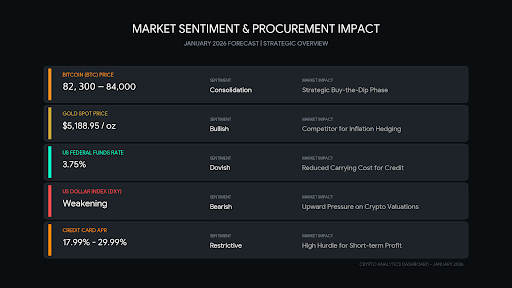
The strategic environment for Bitcoin procurement is inextricably linked to the broader monetary conditions of 2026. Following the decisive supportive turn in late 2025, where the US Federal Reserve reduced interest rates three times adjusting the federal funds rate from 4.5% to 3.75% the global liquidity environment has become more favorable for risk-on assets. However, this period is also characterized by a “risk-off” mindset among certain investor classes, driven by speculation regarding a tighter liquidity stance under a potentially more hawkish Federal Reserve leadership.
Monetary Policy and the Opportunity Cost of Credit
The decision to utilize credit instruments for Bitcoin acquisition involves a complex calculation of real interest rates and anticipated asset appreciation. In 2026, while the Fed has adopted a more dovish stance, the classification of cryptocurrency purchases as “cash advances” by major credit card issuers persists, imposing an immediate cost barrier on the user. The Economic Survey 2026 highlights a global system that no longer rewards macroeconomic success with simple currency stability, creating a “wrinkle in the ointment” for emerging economies like India, where real growth remains strong at 7% but capital inflows are volatile. This volatility underscores the importance of “fast” methods; in an environment where market sentiment can shift rapidly based on Fed chair nominations or technical deleveraging, the speed of credit card processing offers a tactical advantage over slower bank settlement systems.
The following table contextualizes the market environment for Bitcoin relative to traditional benchmarks at the beginning of 2026:
Institutional Adoption and Market Stabilization
In early 2026, the technical outlook for Bitcoin remains pinned below the $90,000 threshold, with immediate support identified near the $80,000 to $81,000 zone. Analysts suggest that this phase of consolidation reflects a broader market transition where Bitcoin is finding support from sustained on-chain activity and institutional interest rather than retail euphoria. The stabilization of volatility is a prerequisite for secure credit card transactions; as the market matures, the risk of catastrophic liquidation during the settlement period decreases, encouraging issuers to maintain or expand crypto-purchase limits.
The Global Regulatory Landscape: Architecting Trust in 2026
The year 2026 marks the era of “Regulatory Clarity,” where the leading financial jurisdictions have moved beyond consultation to full enforcement of cryptocurrency market rules. This shift is critical for credit card users, as it ensures that the “Fast” methods of purchase are also “Secure” through standardized custody and disclosure practices.
The European Union: Full Implementation of MiCA
The EU’s Markets in Crypto-Assets (MiCA) regulation is the most comprehensive legal framework in existence in 2026. It establishes uniform rules for Crypto-Asset Service Providers (CASPs) across the internal market. For the consumer using a credit card, MiCA provides several layers of protection:
Authorization Regime: Only licensed CASPs can accept card payments, ensuring that the platform has met rigorous standards for financial stability and governance.
Disclosure Standards: Issuers of crypto-assets are required to provide clear white papers, informing consumers about risks, including the high cost of using credit for these purchases.
Conflict of Interest Management: The regulation mandates strict separation between the exchange’s assets and client funds, reducing the risk of a “WazirX-style” hack or custody mishap impacting retail users.
By January 2026, the European Securities and Markets Authority (ESMA) is actively overseeing the end of various transition regimes, ensuring that all CASPs operating within the bloc are fully compliant. This has led to a more competitive market where fees for credit card purchases in Europe are among the most transparent globally.
The United States: Alignment through “Project Crypto”
In the United States, the 2026 outlook is defined by a newfound harmony between the Securities and Exchange Commission (SEC) and the Commodity Futures Trading Commission (CFTC). The relaunch of “Project Crypto” in early 2026 aims to provide a joint interpretation of digital asset definitions. This initiative addresses the long-standing confusion regarding whether tokens are classified as securities or commodities, a distinction that previously led to erratic credit card acceptance policies by US banks.
Furthermore, the SEC has issued comprehensive guidance for tokenized securities, enabling blockchain-based finance to expand beyond early experimentation. This regulatory certainty has paved the way for “stablecoin-native” settlement on traditional credit networks, allowing US consumers to use their Visa or Mastercard to buy Bitcoin with a level of oversight that mimics traditional equity trading.
India: The VDA Framework and Tax Implications
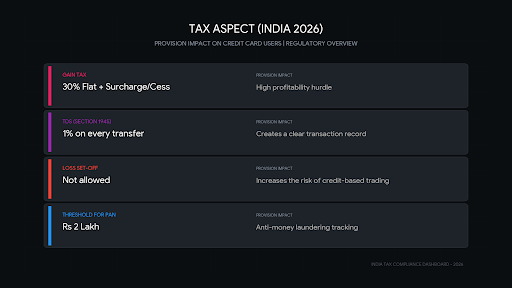
India remains a global leader in crypto adoption, with over 20 million registered users on local exchanges. However, the procurement of Bitcoin via credit cards in India is complicated by a stringent tax regime. Virtual Digital Assets (VDAs) are subject to a 30% flat tax on gains, with no deduction allowed for expenses other than the cost of acquisition.
The lack of a formal market conduct framework in India, compared to the EU or Singapore, means that while the ecosystem is commercially developed, retail users must exercise greater caution when using credit for transactions, as consumer protection mechanisms for “custody mishaps” are still evolving.
Payment Network Infrastructure: Visa, Mastercard, and the Stablecoin Revolution
The technological “plumbing” of the 2026 payment system has been rebuilt to treat Bitcoin and stablecoins as first-class citizens. Visa and Mastercard are no longer just facilitating the purchase of crypto; they are integrating blockchain technology into their core settlement logic.
Visa’s 2026 Strategic Vision: Agentic and Stablecoin-Native
Visa’s Group President, Oliver Jenkyn, has outlined a 2026 where “agentic commerce” moves mainstream. This involves AI agents transacting on behalf of consumers using authenticated, tokenized credentials. For a Bitcoin buyer, this means the card details are never exposed; instead, a secure data token authorizes the AI to execute the buy order when specific conditions are met.
Visa currently supports more than 130 stablecoin-linked card programs in over 40 countries. The shift in 2026 is toward “settlement on the Visa network,” where stablecoin-native clients can settle in USD or EUR stablecoins just like traditional fiat. This drastically reduces the time and cost associated with the fiat-to-crypto bridge, making credit card purchases “fast” by removing the need for intermediary bank clearances.
Mastercard’s Multi-Token Network (MTN)
Mastercard has responded with its Multi-Token Network (MTN), a system designed to handle digital currencies like stablecoins across various regions. In 2026, Mastercard focuses on “supercharging” credit cards with crypto features, such as:
Stablecoin Cashback: Rewards are issued in stablecoins or Bitcoin rather than traditional points.
B2B and P2P Remittances: Using the credit network to send value across borders using Bitcoin as the settlement asset.
Staking Bonuses: For cardholders who hold a certain amount of Bitcoin on an integrated exchange.
Despite this innovation, the 2026 landscape is marked by economic tension. Mastercard, for instance, reported stronger-than-expected profits in late 2025 despite announcing a 4% workforce reduction and a $200 million restructuring charge as it pivots toward these more automated, digital-first technologies.
Security and Authentication: Fast and Frictionless Protection
The primary barrier to credit card crypto purchases in the early 2020s was fraud and the high rate of chargebacks. By 2026, the industry has solved this through the universal adoption of 3D Secure 2.0 (3DS2) and biometric authentication.
The Obsolescence of Manual Guest Checkout
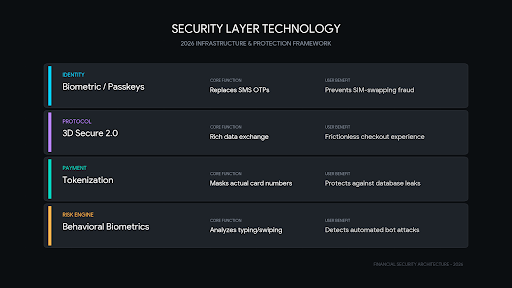
Visa predicts that by 2026, manual entry of card details (the 16-digit number, expiry date, and CVV) will be considered a “relic” of the past. In 2019, nearly 50% of transactions involved manual entry; by 2025, this fell to 16%, and it is expected to vanish almost entirely in 2026. For the Bitcoin buyer, this means a “one-click” experience via digital wallets like Apple Pay, Google Pay, or direct integration within exchange apps, where identity is verified via:
Biometric Scans: Face and palm scans are now mandated by many central banks (such as in the UAE) to replace the insecure SMS one-time password (OTP).
Device Fingerprinting: The 3DS2 protocol analyzes hundreds of data points from the user’s device to verify the transaction’s legitimacy in the background.
Behavioral Biometrics: Systems analyze how a user interacts with their device to detect automated bots or credential stuffing.
3D Secure 2.0 and Strong Customer Authentication (SCA)
The implementation of 3DS2 provides a “frictionless” customer experience compared to the initial version of the protocol. It allows for a rich exchange of data between the merchant (the crypto exchange) and the issuer (the bank), which means low-risk transactions are approved without any user interruption, while high-risk transactions—such as a large, first-time Bitcoin purchase—require an additional biometric authentication step.
The following table summarizes the security layers involved in a typical 2026 Bitcoin purchase:
Comparative Analysis of 2026 Cryptocurrency Exchanges
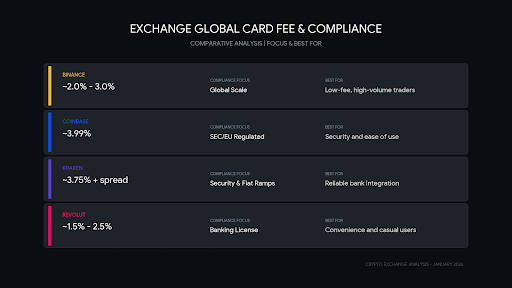
For the professional investor in 2026, the choice of an exchange for credit card procurement is a function of fee structures, regional licensing, and the depth of the “fiat-crypto bridge.”
Binance: The Volume Leader
Binance remains the world’s largest exchange by volume in 2026, with over 150 million traders and a daily volume exceeding $65 billion. It is consistently ranked as the best option for low-fee credit card purchases. However, its use is restricted in certain jurisdictions like the US and UK, where it operates through subsidiary or separate entities to comply with local laws.
Coinbase: The Security Standard
Coinbase is the preferred venue for users who prioritize safety and regulatory compliance over raw fee minimization. Its “Coinbase Fee” varies by region but is typically around 3.99% for global credit card transactions. Coinbase’s primary advantage in 2026 is its deep integration with US and EU financial laws, making it the most “frictionless” choice for institutional and high-net-worth retail users.
Kraken and Specialized Ramps
Kraken continues to be a reliable choice, particularly for its robust fiat on/off-ramps across multiple currencies including USD, GBP, EUR, AUD, CAD, and JPY. While its trading fees may be higher than Binance’s for certain low-cap assets, its security protocols and customer support make it a top contender for credit card users. Additionally, neo-banks like Revolut have become major players, offering a “regulated” experience for buying crypto within a broader banking app, though they often charge a premium for the convenience.
The Financial Mechanics: Understanding the “Cash Advance” Penalty
The most critical insight for anyone buying Bitcoin with a credit card in 2026 is the classification of the transaction. Most banks and credit card issuers treat crypto purchases as “cash advances” rather than standard retail purchases.
Immediate Interest and High Fees
When a transaction is classified as a cash advance, the traditional 21-to-30-day interest-free grace period is waived. Interest begins to accrue the moment the transaction is processed. Furthermore, cash advances typically carry an APR that is significantly higher than the standard purchase rate.
Calculated cost of a $1,000 Bitcoin purchase using a typical 2026 credit card:
Upfront Cash Advance Fee (5%): $50.00
Exchange Processing Fee (3%): $30.00
Total Principal Debt: $1,080.00
Daily Interest Accrual (at 24.99% APR): \approx \$0.74 per day
If the balance is not paid off for 30 days, the user has paid approximately $102 in fees and interest to acquire $1,000 worth of Bitcoin, an effective “convenience tax” of 10.2%. This cost structure means that “Fast” methods are only economically viable if the user expects Bitcoin’s price to appreciate significantly in a very short timeframe or if they intend to pay the balance in full within 48 hours.
Issuer-Specific Restrictions
Even when the networks (Visa/Mastercard) allow the transaction, individual banks may block it. In 2026, some banks (like certain institutions in Canada and Australia) have implemented total bans on using credit for crypto, citing the “systemic risk” to the bank’s capital in the event of a market crash. Conversely, specialized “crypto credit cards” issued by entities like Gemini or Bleap are designed specifically for this purpose, offering reward structures that can offset some of the interest costs.
The Frontier of Agentic Commerce: AI-Driven Bitcoin Procurement
The year 2026 is defined by the shift from “Mobile Commerce” to “Agentic Commerce”. This is the ultimate “Fast” method of buying Bitcoin, where a user no longer interacts with an exchange interface at all.
Mechanism of the AI Agent
An AI agent, such as a custom agent on Google Chrome or a specialized “Buy for Me” button in ChatGPT, is given a goal: “Buy 0.1 BTC using my Mastercard when the price dips to $81,500”.
Connection: The agent is connected to the user’s digital wallet and credit card via the Universal Commerce Protocol (UCP).
Execution: When the price hits the target, the agent uses the Agentic Commerce Protocol (ACP) to negotiate with the exchange’s API.
Verification: The agent “pauses and asks” for the user’s biometric confirmation to complete the purchase.
Logistics: It handles the entire multi-step workflow, from the fiat on-ramp to moving the Bitcoin into a secure self-custody wallet.
Managing “Agentic Debt”
The rise of these agents has introduced a new form of risk: “Agentic Debt”. This occurs when multiple autonomous agents make financial decisions that are untraceable or ungovernable. For the Bitcoin buyer, the risk is that an agent might misinterpret a “flash crash” as a “dip” and execute a large credit card purchase that the user cannot afford. In 2026, responsible AI governance—including a central agent registry and strict behavior alignment—is essential for ensuring that agentic commerce remains a secure method for crypto procurement.
Case Study: Regional Success and Friction in 2026
The experience of buying Bitcoin with a credit card varies wildly depending on geography, reflecting the divergence in regulatory and payment sovereignty.
The UAE: A Hub for Integrated Payments
Dubai has become the first global city to accept crypto for diverse payments, including car insurance premiums. By 2026, the UAE’s Central Bank has mandated a phase-out of SMS OTPs, replacing them with a regional biometric payment system using face and palm scans. For a resident of Dubai, buying Bitcoin with a credit card is as simple and secure as buying a coffee, as the entire digital economy is designed to support the “fiat-crypto bridge”.
The United Kingdom: A Cautious “Gateway”
The UK has taken a more measured approach. While the FCA has decided not to ban using credit for crypto purchases, they have introduced a “licensing gateway” that begins in September 2026. UK users face tighter rules on marketing and must prove they have the “competence” to understand the risks before being allowed to use a credit card for Bitcoin.
India: The “Airbus of European Payments” Inspiration
The European Parliament’s economic and monetary affairs committee has looked toward India’s Unified Payments Interface (UPI) as a model for “European payment sovereignty”. While India’s UPI has leapfrogged card networks, the use of credit cards for Bitcoin in India remains a niche for the wealthy (HNIs and UHNIs), who use it as a tactical tool amid record IPO cycles and strong equity gains.
Strategic Risks and Future Outlook: Toward 2030
As the focus of investors shifts from speculative trading to the development of blockchains with actual utility, the methods for buying Bitcoin will continue to evolve.
The 2030 Projection
Most analysts expect Bitcoin to reach $300,000 to $500,000 by 2030 as focus shifts toward blockchains powered by tokens with utility and cash flows. In this long-term view, buying with a credit card in 2026 is seen as a way to “stack sats” during the final phase of institutional consolidation before the next major supply squeeze.
Emerging Threats: AI Identity Battles
The “AI battle for identity” is the primary security concern of 2026. Criminals now use GenAI to create deepfakes and synthetic IDs to steal entire identities rather than just individual transactions. This means that “Secure” methods must go beyond 3DS2 and include industry-wide partnerships between banks, fintechs, and governments to develop shared risk-management technologies.
The Role of Stablecoins
One thing is certain: stablecoins will be the primary plumbing for Bitcoin purchases. By 2026, they are no longer speculative assets but trusted global infrastructure used for everything from B2B payments to P2P remittances. The ability to buy Bitcoin with a credit card is, in many ways, just a “wrapper” for a stablecoin transaction that takes place behind the scenes on the Visa or Mastercard network.
Summary of Actionable Insights for Bitcoin Procurement
For an investor or professional seeking to utilize credit cards for Bitcoin acquisition in 2026, the following principles govern the “Fast & Secure” methodology:
Prioritize Regulated Ramps: Use exchanges that are MiCA-licensed (in the EU) or have “Project Crypto” alignment (in the US) to ensure custody protections and transparent fee disclosures.
Utilize Biometric Security: Eschew platforms that still rely on SMS OTPs; instead, opt for those integrated with device-native biometrics and 3DS2 frictionless flows.
Calculate the Convenience Premium: Always account for the cash advance classification. Ensure that the 5% upfront fee and the 24.99% APR do not outweigh the anticipated market gains.
Leverage AI Agents Responsibly: Use agentic tools to monitor for “buy the dip” opportunities at technical supports like $81,000, but ensure strict governance is in place to prevent overleveraging.
Monitor Regional Tax and Compliance: In jurisdictions like India, be prepared for the 30% flat tax and 1% TDS, which necessitates meticulous record-keeping.
The convergence of AI, blockchain, and global credit networks has made the “How to Buy” question simpler than ever before, but the “When and At What Cost” remains a matter of strategic financial planning. As Bitcoin continues its trajectory toward becoming a global reserve asset, the credit card remains one of the most powerful, albeit expensive, tools in the investor’s arsenal for securing a position in the digital economy of the future.