





Brent Crude Oil Price vs Bitcoin: Is Oil Driving Crypto Markets in 2026?
Bitcoin moves are often blamed on whales, exchange outflows, or the latest AI-driven trading bot—but what if the real “ghost in the machine” is sitting in a pipeline thousands of miles...

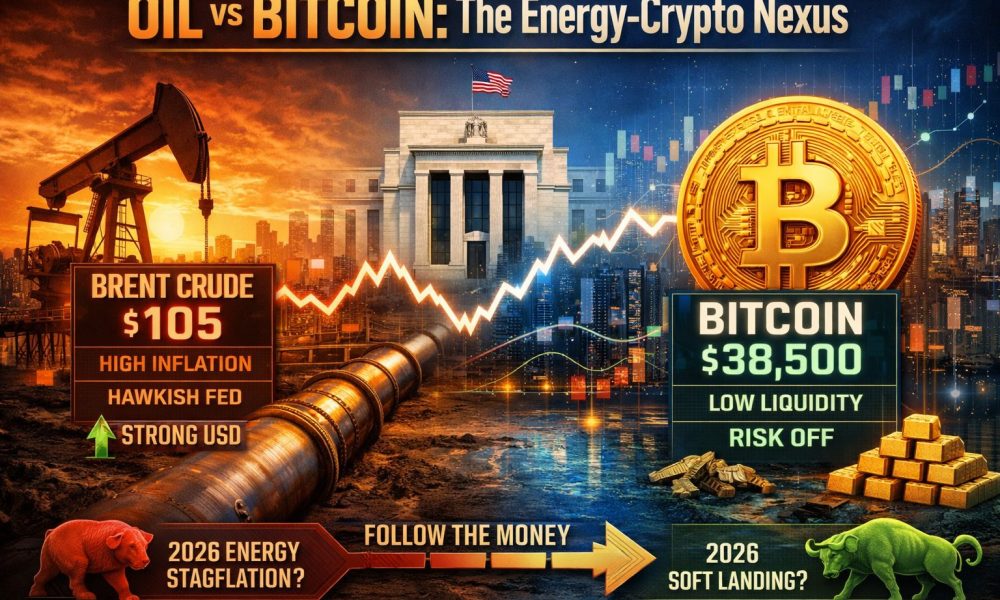
Bitcoin moves are often blamed on whales, exchange outflows, or the latest AI-driven trading bot—but what if the real “ghost in the machine” is sitting in a pipeline thousands of miles away? As we navigate the high-stakes financial landscape of March 2026, a surprising realization is hitting Wall Street: To trade Bitcoin successfully, you must first understand the price of energy.
Table Of Content
- The Global Benchmark: Why Brent Crude Still Dictates the Game
- The Liquidity Chain: How Oil Prices Drain the Crypto Pool
- Bitcoin’s 2026 Identity Crisis: Risk Asset or Macro Hedge?
- The Hidden Link: Energy Costs and the Bitcoin Production Floor
- Brent Oil vs Bitcoin: A Tale of Three Cycles
- Scenario Analysis: Positioning Your Portfolio for 2026
- Final Verdict: Does Oil Rule the Crypto World?
In 2026, the “Energy-Crypto Nexus” is no longer a fringe theory. With Brent Crude Oil hovering near the psychological $105 barrier and Bitcoin testing its historical resistance levels, the correlation between black gold and digital gold has reached a fever pitch. This isn’t just about supply and demand; it’s about the very mechanics of global liquidity.
The Global Benchmark: Why Brent Crude Still Dictates the Game
Brent Crude isn’t just a commodity; it is the oxygen of the traditional economy. While WTI (West Texas Intermediate) is the American standard, Brent is the global benchmark, pricing over 60% of the world’s internationally traded crude oil.
For macro analysts in 2026, Brent serves as the primary “risk-on/risk-off” barometer. When Brent prices surge, the cost of everything—from manufacturing semiconductors to shipping the latest iPhone—increases. In a world still recovering from the supply chain shocks of the early 20s, oil remains the most sensitive trigger for market sentiment. If Brent is volatile, the world is nervous; and when the world is nervous, Bitcoin reacts.
The Liquidity Chain: How Oil Prices Drain the Crypto Pool
To understand the brent crude oil price vs bitcoin relationship, you have to follow the money. The connection isn’t a direct “buy oil, sell crypto” trade; it is a sophisticated domino effect that involves central banks and the global cost of capital:
- Energy-Driven Inflation: Rising oil prices lead to “Cost-Push Inflation.” In March 2026, energy costs accounted for nearly 30% of the volatility in the Consumer Price Index (CPI).
- The Fed’s Iron Hand: When inflation stays “sticky” due to high energy costs, the Federal Reserve cannot cut interest rates. In fact, current 2026 projections show the Fed keeping rates above 3.5% to combat energy-led price surges.
- The Liquidity Siphon: High interest rates make the US Dollar stronger (DXY). Since both Brent and Bitcoin are priced in USD, a surging dollar creates a natural “ceiling” for their prices.
Trader’s Rule: High Oil = High Inflation = Hawkish Fed = Low Liquidity. In a low-liquidity environment, risk assets like Bitcoin are the first to lose their momentum.
Bitcoin’s 2026 Identity Crisis: Risk Asset or Macro Hedge?
Is Bitcoin “Nasdaq on Steroids” or “Digital Gold”? The 2026 data shows that Bitcoin has developed a dual identity that depends entirely on the source of oil price movements.
The “Beta” Identity: When oil rises because the global economy is booming (high demand), Bitcoin often rises with it. Investors are “greedy,” liquidity is flowing, and growth is the priority. In this phase, BTC behaves like a high-performance tech stock.
The “Hedge” Identity: When oil rises because of geopolitical conflict—such as the current tensions affecting the 2026 energy trade routes—Bitcoin’s role shifts. It begins to decouple from the stock market and acts as a “censorship-resistant” store of value, moving in tandem with gold as traditional fiat currencies lose purchasing power.
The Hidden Link: Energy Costs and the Bitcoin Production Floor
One often overlooked aspect of the brent crude oil price vs bitcoin debate is the cost of mining. Bitcoin isn’t printed; it is “extracted” using massive amounts of electricity.
In 2026, despite the shift toward renewable energy, a significant portion of the global power grid is still sensitive to natural gas and oil prices. When Brent Crude spikes, global electricity costs follow. This increases the “production cost” for miners. Historically, whenever Bitcoin’s price approaches its production cost, it creates a “hard floor” where miners refuse to sell, leading to a supply squeeze and a subsequent price bounce.
Brent Oil vs Bitcoin: A Tale of Three Cycles
| Era | Macro Condition | Oil Trend | Bitcoin Reaction |
|---|---|---|---|
| 2020-2021 | Massive Stimulus | Surging | Parabolic Growth |
| 2022-2023 | Rate Hike Shock | Spiking | Deep Bear Market |
| 2024-2026 | Institutional Maturity | Stable to High | High Correlation with Liquidity |
Scenario Analysis: Positioning Your Portfolio for 2026
As we look toward the remainder of 2026, two specific scenarios should be on every investor’s radar:
Scenario A: The “Energy Stagflation” (Bearish)
If Brent Crude stays above $110 while global GDP growth slows, we enter a stagflationary environment. This is the “worst-case” for Bitcoin. The Fed will stay hawkish to fight inflation, but there is no economic growth to support risk-taking. Expect Bitcoin to trade in a sideways, bearish range.
Scenario B: The “Soft Landing Pivot” (Bullish)
If oil prices stabilize around $85-$90, it signals that inflation is under control. This gives the Fed “permission” to cut rates and restart the liquidity printer. In this scenario, Bitcoin is historically known to front-run the market, often seeing 50-100% gains before the first rate cut is even official.
Final Verdict: Does Oil Rule the Crypto World?
Does the brent crude oil price vs bitcoin chart provide a “magic signal” for traders? The answer is a nuanced yes.
Oil is the world’s most important leading indicator for inflation and interest rate policy. In the 2026 market, Bitcoin has matured from a speculative experiment into a core macro asset. It no longer lives in a vacuum. If you are watching Bitcoin’s RSI but ignoring Brent’s breakout, you are trading with one eye closed. In 2026, energy isn’t just used to mine Bitcoin—it’s used to price it.
Disclaimer: This macro analysis is for informational purposes only and does not constitute financial advice. Always perform your own due diligence when trading volatile assets like Brent Crude and Bitcoin.


