





Coinbase vs Binance: Which Crypto Exchange Is Better in 2026?
REPORTING FROM THE DIGITAL FRONTIER As we navigate the first quarter of 2026, the cryptocurrency landscape looks fundamentally different than the “Wild West” era of years past. The dust...

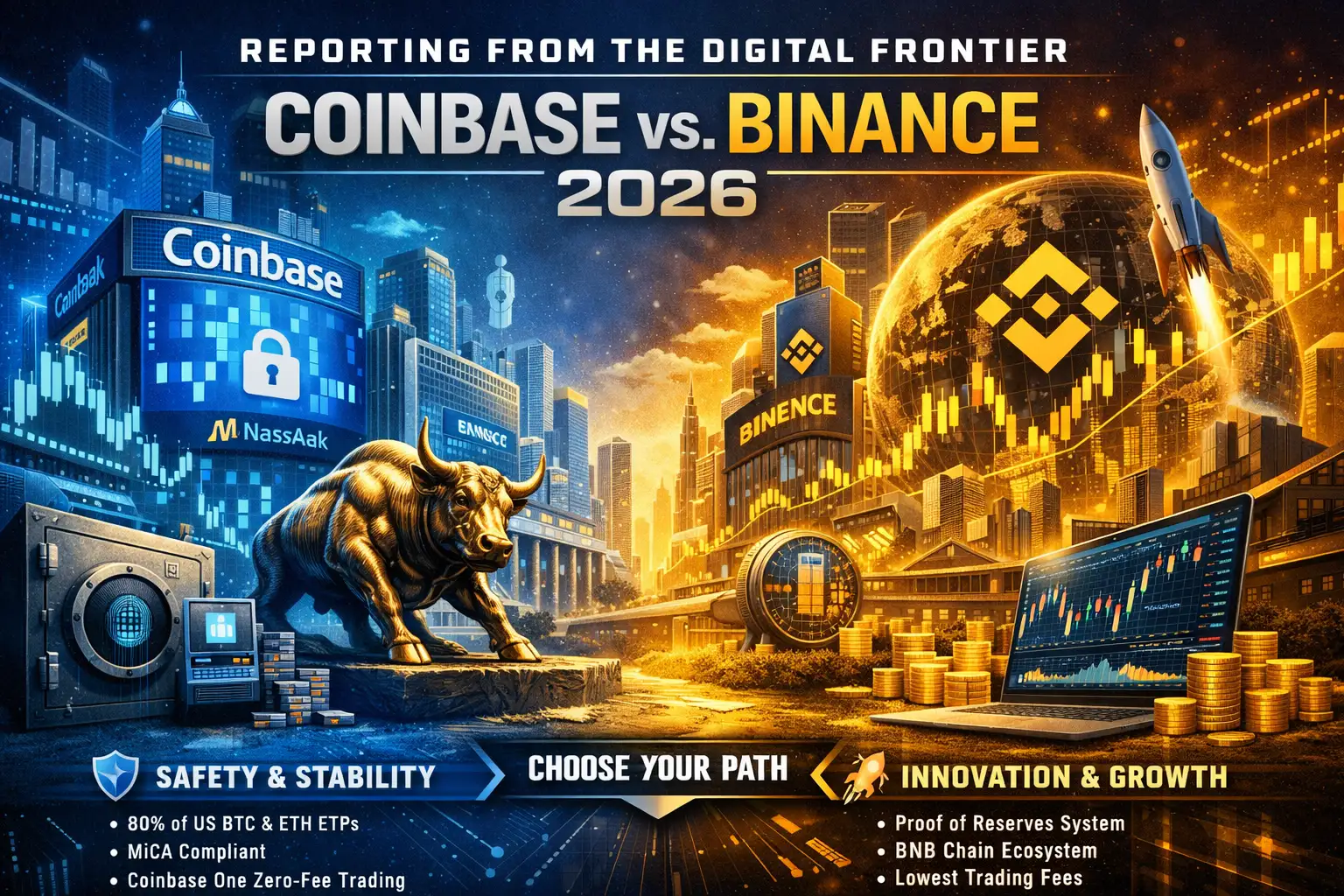
REPORTING FROM THE DIGITAL FRONTIER As we navigate the first quarter of 2026, the cryptocurrency landscape looks fundamentally different than the “Wild West” era of years past. The dust from the regulatory storms of 2023 and 2024 has finally settled, leaving two undisputed titans standing at the summit: Coinbase and Binance.
Table Of Content
- The State of Play: Two Paths to Dominance
- Regulatory Standing and Trust: The Safety First Era
- Coinbase: The Institutional Fortress
- Binance: The Global Pivot
- Fee Structures: The Battle for Your Margin
- The Ecosystem War: Base vs. BNB Chain
- User Experience: Intuition vs. Power
- Security: Can Your Assets Be Stolen in 2026?
- Which One Is Better for YOU?
- Choose Coinbase If
- Choose Binance If
- The 2026 Champion
For investors today, the question is no longer just “where can I buy Bitcoin?” Instead, the dilemma has shifted to “which ecosystem provides the most security, lowest friction, and best yield in a regulated global market?” Whether you are a retail enthusiast or an institutional player, the choice between these two giants has never been more consequential. Let’s break down the 2026 reality of the Coinbase vs. Binance rivalry.
The State of Play: Two Paths to Dominance
In 2026, the “great divide” between these two platforms has widened into a distinct philosophical choice. Coinbase has successfully positioned itself as the “Gold Standard” of Western compliance, acting as the primary bridge for Wall Street’s capital. Meanwhile, Binance, after its massive corporate restructuring and settlement era, has emerged as the “Global Liquidity Engine,” dominating the international markets with an unmatched breadth of assets.
Regulatory Standing and Trust: The Safety First Era
If 2026 has taught us anything, it’s that “regulatory-first” is no longer an option—it’s a survival requirement. This is where the two exchanges show their most significant differences.
Coinbase: The Institutional Fortress
Coinbase enters 2026 as the primary custodian for nearly 80% of the Spot Bitcoin and Ethereum ETFs in the United States. Its public listing on the NASDAQ has provided a level of transparency that remains the benchmark for the industry. For users who prioritize insurance, legal recourse, and “clean” liquidity, Coinbase remains the clear winner. Their expansion into the European market under the MiCA (Markets in Crypto-Assets) framework has been seamless, making them the preferred choice for the “safety-first” demographic.
Binance: The Global Pivot
The Binance of 2026 is a far cry from the decentralized nomad of 2021. Following its multi-billion dollar settlements and the implementation of independent monitors, Binance has transformed into a highly disciplined entity. While it still faces occasional friction in specific jurisdictions, its “Binance Tax” and global licensing spree have paid off. For the non-US user, Binance often offers a more flexible environment while maintaining a rigorous Proof of Reserves (PoR) protocol that is updated in real-time on the blockchain.
Fee Structures: The Battle for Your Margin
In a mature market, fees are where the battle is won or lost. In 2026, we see a bifurcated model that rewards loyalty.
| Feature | Coinbase (2026) | Binance (2026) |
|---|---|---|
| Standard Trading Fee | 0.4% – 0.6% (Retail) | 0.1% (or less with BNB) |
| Subscription Model | Coinbase One ($29.99/mo) | VIP Tiered System |
| Advanced Trade | Maker: 0.05% / Taker: 0.15% | Maker: 0.02% / Taker: 0.04% |
The Verdict on Fees: Binance remains the undisputed king of low-cost trading. If you are a high-volume day trader, the savings on Binance are significant. However, Coinbase One has become a massive hit in 2026, offering zero-fee trading for a flat monthly sub, which is a game-changer for casual investors who DCA (Dollar Cost Average) into the market.
The Ecosystem War: Base vs. BNB Chain
In 2026, we don’t just use exchanges; we use their networks. This is where the competition gets futuristic.
Coinbase’s Base L2: Coinbase has successfully migrated a significant portion of its retail activity to Base, its Layer 2 Ethereum scaling solution. By 2026, Base has become a DeFi powerhouse, hosting thousands of apps that feel as easy to use as a standard banking app. The integration is so seamless that many Coinbase users don’t even realize they are interacting with the blockchain.
Binance’s BNB Ecosystem: Binance has pivoted toward BNB Greenfield and highly scalable sidechains. While Base focuses on the Ethereum ecosystem, BNB Chain in 2026 has become the “Internet of Value” for emerging markets, powering everything from micro-payments in Southeast Asia to supply chain tracking in South America. If you want variety and “DeFi degen” opportunities, Binance’s ecosystem is still more diverse.
User Experience: Intuition vs. Power
Walking through the 2026 versions of these apps reveals two very different design philosophies.
“Coinbase feels like the future of banking; Binance feels like the future of trading.” 2026 Industry Analyst
- Coinbase: The interface is minimalist, “Apple-esque,” and focuses on long-term wealth management. Their AI-driven “Smart Portfolio” features now give users personalized advice based on their risk tolerance.
- Binance: The “Pro” mode remains the most powerful tool in the industry. For a technical analyst, Binance’s charting tools, depth maps, and multi-asset collateral options are lightyears ahead of Coinbase. However, for a beginner, the sheer number of options can still be overwhelming.
Security: Can Your Assets Be Stolen in 2026?
Security has moved beyond two-factor authentication. In 2026, both exchanges utilize MPC (Multi-Party Computation) wallets, ensuring that there is no single point of failure.
Coinbase offers “Coinbase Vault,” which now includes enhanced time-delayed withdrawals and biometric verification that is nearly impossible to spoof. Binance has doubled down on its SAFU (Secure Asset Fund for Users), which, by 2026, is valued at over $2 billion, providing a massive insurance cushion against potential exploits.
Which One Is Better for YOU?
Choose Coinbase If:
- You live in the US or Europe and prioritize regulatory peace of mind.
- You want a “set it and forget it” investment style.
- You are an institutional investor or a high-net-worth individual requiring white-glove custody.
- You value a clean, distraction-free user interface.
Choose Binance If:
- You are an active trader looking for the lowest possible slippage and fees.
- You want access to the widest variety of “altcoins” and early-stage projects.
- You utilize advanced derivatives, futures, and sophisticated staking products.
- You live outside of the US and want a global financial hub with deep liquidity.
The 2026 Champion
As we look at the data for 2026, there is no “universal” winner, but there is a strategic winner.
If we define “better” as stability and mainstream integration, Coinbase takes the trophy. They have successfully bridged the gap between traditional finance and the crypto-economy, making digital assets a boring (and safe) part of a standard retirement portfolio.
However, if we define “better” as innovation, utility, and market depth, Binance remains the king. No other platform can match their engine’s speed or the sheer volume of their peer-to-peer (P2P) marketplace, which has become a lifeline for millions in the global south.
In 2026, many savvy investors have stopped choosing. They use Coinbase for their long-term “Cold” storage and Binance for their active “Hot” trading. In the world of 2026 crypto, diversification isn’t just about what you buy it’s about where you hold it.
Disclaimer: The cryptocurrency market remains volatile. This report is based on current 2026 market trends and data. Always conduct your own due diligence before investing.


