


DEX Trading in 2026: How Decentralized Exchanges Work, Real Risks, and a Smart User Playbook
A DEX (decentralized exchange) is where you trade crypto directly from your wallet, without handing custody to an exchange. That single difference changes everything: how trades execute, what...

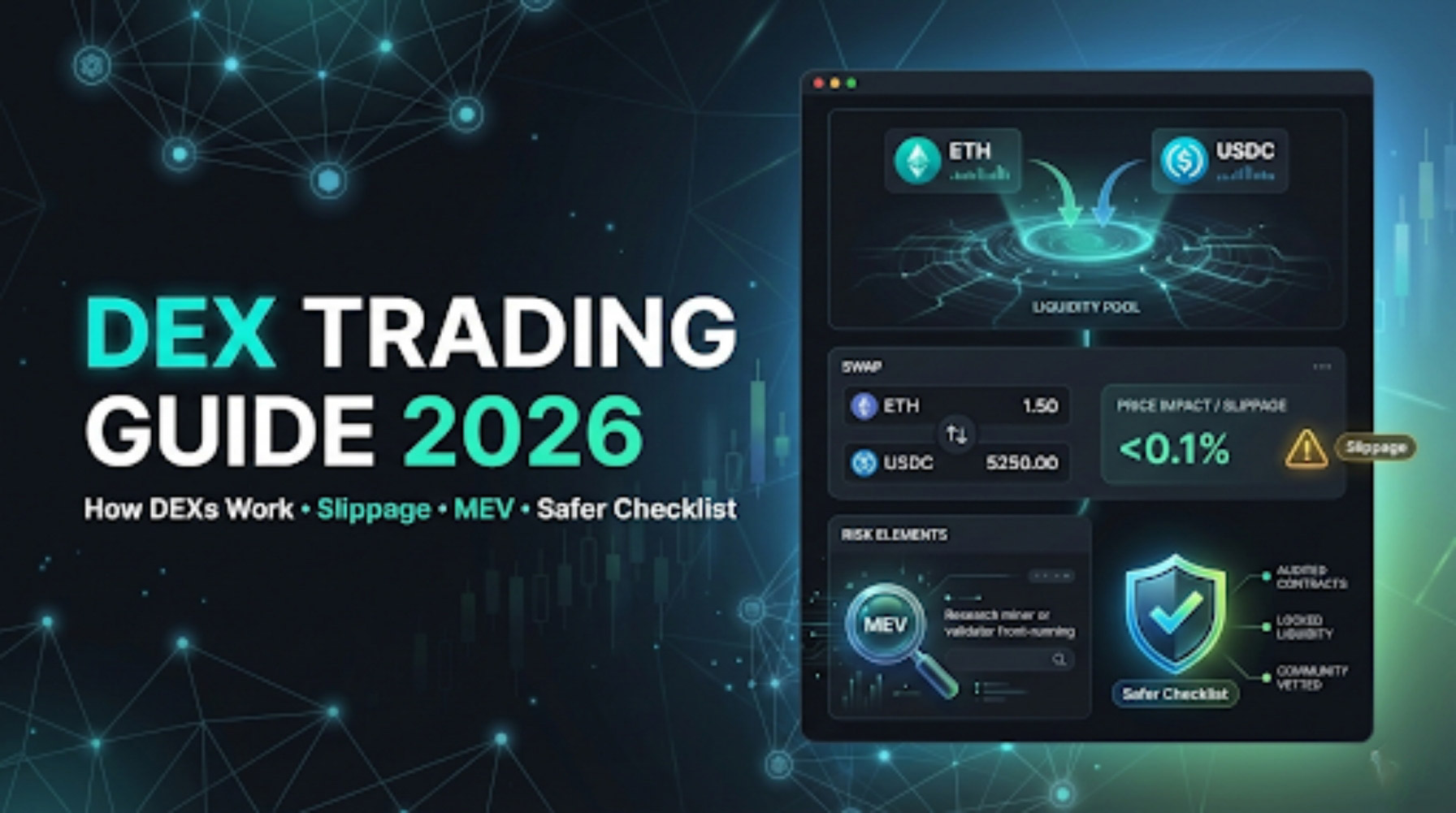
A DEX (decentralized exchange) is where you trade crypto directly from your wallet, without handing custody to an exchange. That single difference changes everything: how trades execute, what “liquidity” really means, which risks matter, and why security hygiene is non-negotiable.
What’s Covered
- What a DEX actually is (and what it isn’t)
- DEX vs CEX: the trade-off in one table
- How DEX trades happen under the hood
- 1) AMMs (Automated Market Makers)
- 2) On-chain order books
- 3) RFQ / intent-based routing (common in 2025–2026)
- The DEX risk map (what actually gets people in trouble)
- Slippage: the most misunderstood cost
- MEV: why bots “see” your trade before it lands
- Token approvals: the quiet permission that can wreck you
- Fake tokens and lookalikes: the #1 DEX trap
- Smart contract risk (yes, even for “blue chip” DeFi)
- Impermanent loss (IL): only for liquidity providers—still important
- How to use a DEX safely: a step-by-step playbook
- Step 1) Start with the wallet setup (non-negotiable)
- Step 2) Verify the token before you verify the chart
- Step 3) Use realistic settings
- Step 4) Prefer better routing and reduce MEV exposure
- Step 5) Keep a clean post-trade routine
- DEXs into 2026: what trends actually matter
- DEX user types in 2026: a practical playbook for beginners, intermediates, and pros
- Beginner: “I want simple swaps, minimal risk”
- Intermediate: “I care about execution, fees, and MEV”
- Pro: “I run size, use DeFi strategies, and manage tail risk”
- Which track should you choose right now?
- A quick “am I ready for DEX?” checklist
Reader note:
- This guide is informational, not financial advice.
- On-chain trading is permanent. A wrong click can’t be reversed.
- Security matters more on DEXs because you are the custodian.
What a DEX actually is (and what it isn’t)
In plain terms, a DEX is a trading venue powered by smart contracts. You connect a wallet, sign a transaction, and the swap settles on-chain. There’s no “account” in the traditional sense—your wallet address is your identity.
That also means two important clarifications:
- A DEX is not automatically “safer” than a centralized exchange. You avoid exchange custody risk, but you take on smart contract risk and user-error risk.
- A DEX is not always permissionless end-to-end. The protocol may be open, while specific front-ends can restrict regions or tokens. The blockchain settlement remains the same.
If you need a clean baseline for wallets before you touch any DEX, start here:
What a Web3 wallet is and
How to create a crypto wallet.
DEX vs CEX: the trade-off in one table
| Feature | DEX (on-chain) | CEX (centralized) |
|---|---|---|
| Custody | You hold keys (self-custody) | Exchange holds keys (custodial) |
| Execution | On-chain transaction (gas + confirmation) | Off-chain matching engine (instant fill) |
| Liquidity | Pools / on-chain order books / RFQ | Order books (deep, often tighter spreads) |
| Key risks | MEV, slippage, fake tokens, smart contract bugs, approvals | Counterparty risk, withdrawals paused, account locks, hacks |
| Transparency | On-chain, auditable flows | Opaque internal ledgers |
How DEX trades happen under the hood
DEXs generally fall into three execution models. Understanding the model tells you what to expect from slippage, fees, and “why your trade filled worse than you thought.”
1) AMMs (Automated Market Makers)
AMMs use liquidity pools instead of a traditional order book. You swap against a pool (e.g., Token A / Token B). The price moves based on the pool’s balance after your trade.
- Best for: simple spot swaps, long-tail assets, 24/7 permissionless liquidity.
- Main cost: slippage when pools are thin or your order is large.
- Hidden factor: MEV (bots can sandwich trades when settings are careless).
2) On-chain order books
Some DEXs use order books on-chain. This can offer more “traditional” trading behavior, but costs/throughput depend heavily on the chain.
3) RFQ / intent-based routing (common in 2025–2026)
More DEX flows are moving toward “request-for-quote” or intent-based routing, where you express the trade you want and solvers/market makers compete to fill it. Done right, this can reduce MEV and improve execution.
The DEX risk map (what actually gets people in trouble)
Most DEX losses don’t come from “market going down.” They come from mechanics, approvals, or interacting with the wrong asset/contract. Here are the risks that matter.
Slippage: the most misunderstood cost
Slippage is how much worse your fill can be versus the displayed price. It grows when:
- the pool is small (thin liquidity),
- your trade size is large,
- volatility spikes,
- you use very high slippage tolerance.
Practical rule: if you need high slippage tolerance to make a trade go through, you’re often trading something illiquid—or something risky.
MEV: why bots “see” your trade before it lands
Because transactions sit in a public mempool (on many chains) before confirmation, bots can detect swaps and attempt to profit from them. The classic version is the sandwich: a bot buys before you and sells after you, pushing your fill worse.
- MEV gets worse when you set large slippage tolerance.
- MEV can be reduced with better routing, private relays, or MEV-aware swaps (depending on chain/tooling).
Token approvals: the quiet permission that can wreck you
On many DEXs you must “approve” a token before swapping. That approval can be:
- exact amount (safer), or
- unlimited (convenient, but risky if the spender contract is compromised).
Self-custody security matters here. If you want a full framework, see:
Ultimate crypto security guide.
Fake tokens and lookalikes: the #1 DEX trap
DEXs list anything that can be deployed as a token. That means scammers can create lookalikes with:
- same name/symbol,
- similar logo,
- fake “verified” social proof.
Before buying anything new or trending, follow:
How to spot fake tokens.
Smart contract risk (yes, even for “blue chip” DeFi)
A DEX is code. Bugs, bad upgrades, compromised admin keys, or economic exploits can cause losses. Security is never binary; it’s a spectrum.
To build a threat model mindset, also read:
How modern scams bypass wallet security.
Impermanent loss (IL): only for liquidity providers—still important
If you provide liquidity to pools, you can face impermanent loss: you may end up with fewer of the asset that went up and more of the one that went down. Fees can offset IL, but not always.
If your goal is yield, compare DEX LP risks to other methods:
Crypto passive income guide (2026).
How to use a DEX safely: a step-by-step playbook
Step 1) Start with the wallet setup (non-negotiable)
- Use a separate “hot” wallet for DEX activity (don’t keep your entire net worth in it).
- Enable basic device security and avoid random browser extensions.
- Consider a hardware wallet if you actively trade or hold meaningful amounts:
Best cold wallets.
Step 2) Verify the token before you verify the chart
- Confirm you have the correct contract address.
- Check liquidity depth (thin pools = slippage traps).
- Be skeptical of “too perfect” social hype.
Step 3) Use realistic settings
- Slippage: keep it as low as practical; avoid high tolerances unless you fully understand why you need them.
- Gas: don’t chase “fastest” blindly; spikes can turn small trades into expensive mistakes.
- Trade size: break large orders into smaller ones when liquidity is thin.
Step 4) Prefer better routing and reduce MEV exposure
In 2026, the difference between “a DEX” and “a good DEX experience” is often the router/aggregator layer. Better routing can lower slippage and reduce MEV impact.
On the “tools” side of your workflow, it helps to have alerts and tracking:
Best price alert tools (2026) and
Best crypto apps (2026).
Step 5) Keep a clean post-trade routine
- Review approvals periodically; remove ones you don’t need.
- Move profits back to a safer wallet if you’re active.
- Document entries/exits if you track performance or taxes:
Best crypto portfolio trackers.
DEXs into 2026: what trends actually matter
DEXs are maturing fast. Here are the trends that will likely shape user experience and market structure into 2026:
- Better execution layers: more RFQ and intent-based designs to reduce MEV and improve pricing.
- More liquidity on fast chains: lower fees increase retail participation—but also increase scam velocity.
- Cross-chain complexity: bridging is still a risk hotspot; prefer simpler routes and stronger opsec.
- Institutional DeFi pressure: compliance, risk controls, and “permissioned” rails may expand alongside open DeFi.
For the bigger picture around DeFi adoption, see:
DeFi’s institutional breakout thesis.
DEX user types in 2026: a practical playbook for beginners, intermediates, and pros
Most DEX mistakes happen when people use “pro-level” tools with “beginner-level” habits. Use the track that matches your current skill—not your ambition.
Beginner: “I want simple swaps, minimal risk”
- Primary goal: swap major tokens safely (ETH, stablecoins, large-cap assets) without getting trapped by fake tokens or bad settings.
- Default setup: small position sizes, low slippage tolerance, simple routes, and a separate wallet for DEX activity.
- Rules that save beginners:
- Verify token contracts before every trade (especially if it’s trending).
- Avoid “unlimited approvals” unless you understand approval risk. Prefer exact approvals when possible.
- Don’t chase memes on day 1. Thin liquidity + hype is where slippage and traps live.
Start with wallet and safety fundamentals:
What a Web3 wallet is,
How to create a crypto wallet, and
How to spot fake tokens.
Intermediate: “I care about execution, fees, and MEV”
- Primary goal: reduce slippage, improve fills, and avoid getting sandwiched during volatile periods.
- Default setup: MEV-aware routing (where available), disciplined slippage settings, and trade splitting when pools are thin.
- Intermediate habits that improve outcomes:
- Watch liquidity depth before you size the trade.
- Track funding/open interest sentiment if you trade around events.
- Use alerts so you don’t react late (and pay worse execution).
Build a stronger tooling layer:
Best crypto price alert tools and
Best crypto apps (2026).
Pro: “I run size, use DeFi strategies, and manage tail risk”
- Primary goal: consistent execution under stress, risk compartmentalization, and protection against smart-contract and ops failures.
- Default setup: multiple wallets by purpose (trading / LP / long-term), hardware wallet for significant funds, routine approval hygiene, and disciplined exposure limits per protocol.
- Pro-level risk controls:
- Assume exploits happen. Limit exposure per contract and diversify venues.
- Operational security (opsec) is part of trading. Separate devices/accounts where needed, and avoid “click-first” behavior.
- Stress test liquidity. Ask: “If the market moves 10–15% fast, can I exit without getting wrecked by slippage?”
Pro users should keep security frameworks close:
Ultimate crypto security guide and
How modern scams bypass wallet security.
Which track should you choose right now?
- If you’ve ever bought the wrong token or used high slippage “because it wouldn’t swap,” you’re still in the Beginner track—no shame, just safety.
- If you understand slippage, liquidity depth, and MEV basics and you actively optimize execution, you’re Intermediate.
- If you routinely manage approvals, use multiple wallets, cap per-contract exposure, and think in failure modes, you’re closer to Pro.
A quick “am I ready for DEX?” checklist
Open the checklist
- I understand self-custody basics and can recover my wallet safely.
- I verify token contract addresses and liquidity before trading.
- I keep slippage tolerance low and know why I would raise it.
- I know MEV exists and I avoid reckless settings that invite it.
- I use a separate wallet for DEX activity (risk compartmentalization).
- I avoid hype-driven trades and recognize bubble behavior:
Crypto bubbles explained.


