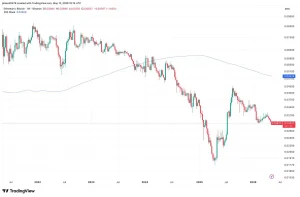
The dawn of 2026 has ushered in a period of profound complexity for global financial markets, challenging the foundational axioms of asset allocation and risk management. As investors navigate a landscape scarred by renewed geopolitical instability in the Middle East, a contentious struggle for independence at the United States Federal Reserve, and shifting inflationary expectations, the search for safety has become the dominant theme of capital deployment. However, the definition of “safety” itself is undergoing a radical bifurcation. The traditional safe haven Gold has surged to unprecedented heights, smashing through record levels above $4,600 per ounce as it fulfills its millennia-old mandate as a hedge against chaos and currency debasement. In stark contrast, Ethereum (ETH), the asset most frequently heralded by digital proponents as “ultrasound money” or the “digital oil” of the future, has exhibited a perplexing sluggishness, largely consolidating within a tight range while the precious metal soars.
This divergence has catalyzed a fierce debate among institutional allocators, retail traders, and macroeconomic strategists. Has the narrative of Ethereum as a “safe haven” failed? Is the “digital gold” thesis dead? This comprehensive research report argues that such binary conclusions are fundamentally flawed. The market is not witnessing the failure of Ethereum as a hedge, but rather the maturation of Ethereum into a distinct asset class that hedges against a completely different set of risks than Gold. While Gold is actively pricing in the instability of the current geopolitical and monetary order, Ethereum is being quietly repriced by the world’s largest asset managers led by BlackRock as the foundational infrastructure for the digitized financial system of the future.
Through an exhaustive analysis of market data from early January 2026, including specific institutional flows, legislative developments like the “Genius Act” and “Clarity Act,” and technical upgrades such as “Fusaka,” this report illuminates the nuanced reality of the trade. We posit that investors are mistaking Ethereum’s lack of immediate correlation with war headlines for weakness, when in fact, its correlation is shifting toward its utility as the settlement layer for the $298 billion stablecoin economy and the burgeoning market of tokenized Real World Assets (RWAs).
The following analysis dissects the macroeconomic triggers of 2026, the structural transformations within the Ethereum network, the regulatory tailwinds reshaping the crypto landscape, and the yield dynamics that pit Ethereum staking against U.S. Treasuries. It reveals that the “new safe haven trade” is not a choice between Gold and Ethereum, but a recognition that they are complementary hedges: one against the destruction of value in the analog world, and the other for the preservation of value in the digital one.
The Macroeconomic and Geopolitical Crucible of 2026
To understand the diverging price actions of Ethereum and Gold, one must first deeply contextualize the environment in which they are trading. The first weeks of January 2026 have been characterized not by the optimistic “soft landing” scenarios that permeated late 2025, but by a sharp resurgence of systemic fears that have historically sent capital fleeing into hard assets.
The Crisis of Central Bank Independence
Perhaps the most significant driver of market anxiety in early 2026 is the deteriorating relationship between the Executive Branch of the United States government and the Federal Reserve. Financial markets despise uncertainty regarding monetary policy, and January delivered a shock to the system with reports of a criminal investigation into Federal Reserve Chair Jerome Powell regarding testimony given in June 2025.
This development is far more than political theater; it strikes at the heart of the “risk-free” rate and the credibility of the U.S. dollar. Institutional investors view the independence of the central bank as a bulwark against politically motivated monetary debasement—specifically, the pressure to lower interest rates prematurely to juice the economy before midterm elections or to service spiraling national debt. The investigation has been interpreted by market commentators as a direct attempt by the Trump administration to exert pressure on the Fed.
When the autonomy of the issuer of the global reserve currency is questioned, the premium on non-sovereign assets expands rapidly. Gold, having no counterparty risk and no political master, becomes the primary beneficiary of this institutional erosion. Its ascent to $4,620 is a direct, linear reaction to the perception that the U.S. dollar’s guardians are under siege. Conversely, Ethereum, while also a non-sovereign asset, is still viewed through the lens of a “risk asset” or a technology stock by many macro algorithms. In moments of acute institutional crisis, liquidity often contracts for tech-correlated assets while flowing into the deepest, most historic pools of liquidity namely, gold and short-term treasuries.
The Iran Tariff Shock
Compounding the domestic institutional crisis is a severe escalation in geopolitical tensions. In early January 2026, President Trump announced a 25% tariff on any country trading with Iran, following widespread protests and threats of military strikes. This announcement introduced a sudden, violent variable into global trade equations, threatening to disrupt energy supply chains and alienate key diplomatic partners.
The market reaction was textbook “risk-off.” Traditional safe havens rallied sharply. Gold surged, silver followed, and the Swiss Franc strengthened. However, the crypto market reacted with trepidation. Bitcoin briefly tested $92,000 before retreating to $90,000, and Ethereum slipped towards $3,150.
This decoupling during the “tariff shock” highlights a critical misunderstanding of Ethereum’s current market profile. Investors expecting ETH to act as a beta-hedge to war headlines were disappointed. The rationale for this is liquidity preference. In the immediate aftermath of a geopolitical shock, market participants prioritize liquidity and capital preservation above all else. While Ethereum is liquid, it is still significantly more volatile than Gold. Traders often sell liquid, profitable positions in crypto to cover margin calls elsewhere or to move into cash and gold. Thus, in the short term, Ethereum behaves like a tech stock during war scares it sells off. It is only over longer time horizons, as the monetary consequences of war (printing money to fund conflict) become clear, that crypto assets tend to catch up.
Inflation and Employment
Beneath the headlines, the U.S. economic data presents a mixed picture that complicates the Fed’s path. The December headline CPI held at 2.7%, with core inflation at 2.6% the lowest since 2021. This benign inflation data would typically be bullish for risk assets like Ethereum, as it supports the case for rate cuts. Indeed, expectations of near-term Fed rate cuts remain a key support level for the crypto market.
However, the labor market is showing signs of cooling, which introduces recession risk. December’s jobs report indicated a slowdown in hiring, which, when combined with the “Benign” inflation, suggests the economy might be stalling. The “recession trade” typically favors bonds and gold over growth assets. This places Ethereum in a difficult position: it needs rate cuts (liquidity) to rise, but it needs growth (network usage) to sustain its valuation. Gold, on the other hand, thrives in stagflationary environments where growth is low (recession) but monetary debasement risks (political pressure on the Fed) are high.
The Yield Curve and Treasury Competition
The U.S. Treasury market remains the elephant in the room for any “safe haven” discussion. As of January 9, 2026, the yield on the 10-year Treasury note stood at 4.18%. The yield curve has exhibited volatility, with the “10-2” spread (the difference between the 10-year and 2-year yields) flashing signals that recession watchers track closely.
With a risk-free rate above 4%, the hurdle for alternative assets is high. An investor allocating to Ethereum must believe that its total return (staking yield + price appreciation) will significantly outperform a guaranteed 4.18% return. As we will explore in later sections, the narrowing gap between Ethereum’s staking yield (~3.5%) and the Treasury yield has created a headwind for ETH that Gold (which yields 0%) ironically does not face, because Gold is not bought for yield—it is bought for insurance.
Gold in 2026, The Renaissance of the Classical Safe Haven
If 2026 has a protagonist in the financial markets so far, it is undoubtedly Gold. The yellow metal has staged a renaissance, breaking free from years of consolidation to chart a vertical path that has left analysts scrambling to update their price targets.
Anatomy of the Breakout
The price action of Gold in January 2026 has been nothing short of historic. By mid-January, Gold futures were trading comfortably above $4,600, with the spot price mirroring this strength.
Gold Futures (Comex) Market Structure – January 12, 2026
The data reveals a market in “contango,” where future delivery prices are progressively higher than spot prices (e.g., December 2026 contracts trading at nearly $4,800). This structure is bullish; it implies that the market is willing to pay a premium to lock in future supply, anticipating that prices will continue to rise. The heavy volume in the February contract (over 225,000 contracts) confirms that this is not a retail-driven anomaly but a broad-based institutional repricing.
Central Banks and the “Diversification Mirage”
Why is Gold rising so aggressively? The answer lies beyond simple inflation hedging. It is about the “weaponization” of finance.
Sovereign Accumulation: Nations outside the G7 orbit, particularly the expanded BRICS bloc, continue to aggressively accumulate gold reserves. The seizure of assets in previous years has taught central banks that U.S. Treasuries carry sanction risk. Gold does not. The relentless bid from central banks puts a “floor” under the price that speculative flows cannot easily break.
The Failure of Traditional Correlation: BlackRock’s 2026 outlook report introduces the concept of the “Diversification Mirage.” It argues that in a regime of high debt and supply shocks, stocks and bonds may fall together (positive correlation), destroying the safety of the traditional 60/40 portfolio. Investors are thus forced into “Plan B” assets—private credit, infrastructure, and commodities like Gold.
The “Fed Independence” Premium: As noted, the political pressure on the Fed creates a scenario where the dollar could be sacrificed for political expediency. Gold is the direct hedge against this “fiscal dominance.”
Technical Dominance
From a technical analysis perspective, Gold is in “blue sky” discovery mode. Having cleared the psychological resistance of $4,500, there is no overhead supply (no “bag holders” waiting to sell at breakeven). Technical analysts note that Gold is consistently printing “higher highs and higher lows,” a structure that algorithmic trend-following funds aggressively buy. The $4,450-$4,480 zone, once a formidable resistance, has flipped into a massive support level, acting as a “line in the sand” for bulls.
Gold vs. The “Digital” Competition
It is notable that Gold’s rally has occurred even as Bitcoin has consolidated. This dispels the notion that Bitcoin acts as a perfect substitute for Gold. In Jan 2026, Gold has proven to be the superior crisis hedge. When the missiles are readied and the subpoenas are served to central bankers, the world still turns to the physical metal.
The Ethereum Enigma, Stagnation or Accumulation?
While Gold enjoys its moment in the sun, Ethereum presents a more complex, arguably more intellectual, investment case. To the casual observer tracking price tickers, Ethereum appears to be lagging. Trading between $3,000 and $3,200, it has failed to break its all-time highs and has significantly underperformed Gold in percentage terms year-to-date.
However, price is often a lagging indicator of fundamental value. Beneath the surface, Ethereum is undergoing a metamorphosis that is arguably more significant than Gold’s price appreciation.
Price Action and Correlation Breakdown
Ethereum’s performance in early 2026 has been range-bound.
Price: Hovering near $3,118 – $3,265.
Volatility: High relative to Gold, but “milder drawdown” than past crypto cycles.
Correlation: During the Iran tariff news, ETH fell 3.23% while Gold rose. This confirms that the market currently treats ETH as a risk-on asset. It rises when liquidity conditions are loose and “animal spirits” are high, and falls when fear grips the market.
This correlation profile is the primary reason why investors claim the “safe haven” narrative is wrong. If it falls when war starts, how can it be a safe haven? The answer lies in the time horizon and the type of safety being sought.
The “Gold-Like” Fractal
Despite the short-term decoupling, sophisticated technical analysts have identified a compelling long-term pattern. Ethereum is currently tracing a price structure that is eerily similar to Gold’s breakout pattern from previous decades.
The Pattern: Gold traded sideways for years, tested a breakout line, failed, consolidated, and then surged 142%. Ethereum has traded in a macro range for nearly four years (since the 2021 peaks), tested the breakout, and is now consolidating at the exact same relative point in the cycle.
The Trigger Level: Analysts identify $3,248 as the critical daily close level. A sustained move above this price would confirm the breakout, potentially unlocking a path to $4,000 and eventually $9,000, mirroring the delayed explosive catch-up of precious metals.
The “Ultrasound Money” Debate, A Narrative Shift
For years, the bull case for Ethereum rested on “Ultrasound Money” the idea that after the “Merge” to Proof-of-Stake, the burning of ETH transaction fees (EIP-1559) would make the asset deflationary, scarcer than Bitcoin or Gold.
In 2026, this narrative has evolved, and in some ways, weakened.
The Impact of Layer 2s: The success of Ethereum’s roadmap is its own worst enemy regarding token scarcity. Layer 2 solutions (Arbitrum, Base, Optimism) have become wildly efficient at bundling transactions. They pay less rent to the Ethereum mainnet for security.
The “Fusaka” Upgrade: The implementation of the Fusaka upgrade in late 2025 further lowered structural costs.
The Result: Net issuance of ETH has remained “modestly positive” (inflationary) during periods of lower network activity because the burn rate no longer consistently outpaces the issuance of staking rewards.
Implication: ETH is no longer a “pure monetary asset” defined by absolute scarcity. It is evolving into a “leveraged claim on ecosystem activity.” Its value is derived from the volume of the digital economy it secures, not just the scarcity of the token itself. This shifts the investment thesis from “Digital Gold” (Store of Value) to “Digital Oil” or “Digital Equity” (GDP of the Internet).
The Specifics: This included roughly 46,851 ETH, valued at approximately $149 million at the time of purchase.
The Timing: Crucially, these purchases occurred during a price dip, when ETH was trading near $3,142 and Bitcoin near $90,000.
The Signal: This was not a momentum trade. It was a strategic accumulation of inventory. BlackRock is effectively “restocking the shelves” for its digital product lines. When the world’s largest asset manager buys the dip with nine-figure sums, it establishes a “soft floor” for the asset price, significantly altering the risk profile for other allocators.
“Micro is Macro”, The Report that Changed the Narrative
On January 13, 2026, BlackRock released its “2026 Global Outlook,” a document that has rippled through financial circles. The core theme is “Micro is Macro” the idea that specific technological shifts (micro) are now large enough to drive macroeconomic outcomes.
Stablecoins as Infrastructure: The report argues that stablecoins are no longer niche trading chips but “core infrastructure” for the global payment system. They are “digital dollar rails” that bridge traditional finance and digital liquidity.
Ethereum’s Role: BlackRock explicitly identifies Ethereum as the “core settlement layer” for this new economy. While other chains might be faster for buying coffee, Ethereum is the “bedrock” where institutions settle high-value transactions because it offers the deepest liquidity and the most robust security model.
Tokenization: The firm highlights that tokenized assets (RWAs) are growing exponentially. BlackRock’s own BUIDL fund, a tokenized money market fund on Ethereum, has surpassed $2 billion in assets.
Larry Fink’s Vision: In accompanying commentary, CEO Larry Fink and COO Rob Goldstein compared the current state of tokenization to the internet in 1996. They argue that ledgers are being modernized for the first time since the invention of double-entry bookkeeping, and that tokenization will “greatly expand the world of investable assets”.
The Insight: This institutional thesis redefines Ethereum’s “Safe Haven” status. It is not a haven from war; it is a haven from technological obsolescence. Institutions are buying ETH to ensure they have a stake in the settlement layer of the future. They are hedging against the risk that the traditional banking rails (SWIFT, ACH) become the “fax machines” of the 2030s.
The Regulatory Winds of 2026, From Headwinds to Tailwinds
For years, regulatory uncertainty was the primary “risk” associated with crypto. In 2026, regulation is rapidly becoming its strongest tailwind, further differentiating it from the unregulated nature of Gold.
The GENIUS Act
Signed into law on July 18, 2025, the GENIUS Act (Guidance for Enforcement of New Innovative Underwriting Systems) established a federal regime for payment stablecoins in the U.S..
Impact: It removed the existential threat that stablecoins might be banned. It created strict reserve and transparency requirements, which ironically made stablecoins “safe” enough for banks to touch.
Connection to ETH: Since the vast majority of institutional-grade stablecoins (like USDC) settle on Ethereum, this act effectively legitimized the traffic flowing through the Ethereum network. It turned Ethereum from a “grey market” highway into a federally recognized toll road for digital dollars.
The CLARITY Act
Looking ahead, the CLARITY Act is expected to pass in Q1 2026.
Purpose: This legislation aims to provide definitive market structure rules, finally settling the “security vs. commodity” debate that has plagued the industry for a decade.
Consequence: Standard Chartered predicts that the passage of this act will be the catalyst that sends Ethereum to $4,000 and beyond. It will allow for more complex financial products, such as Staked ETH ETFs (discussed below), to be approved by regulators who now have a clear rulebook.
Global Standards, The ADGM Framework
Beyond the U.S., the Abu Dhabi Global Market (ADGM) has implemented a rigorous regulatory framework that is setting the global standard. Binance, the world’s largest exchange, became the first to secure full authorization under this framework in late 2025.
Significance: This aligns crypto market structure with traditional financial venues. It covers custody, clearing, and risk management. For institutional investors, this reduces “counterparty risk” the fear that the exchange holding your assets will collapse (like FTX did). With regulated venues and clear laws, the “infrastructure risk” of holding ETH drops, increasing its attractiveness as a long-term store of value.
The Yield War, Staking vs. Treasuries
In a high-interest-rate environment, an asset that yields 0% (like Gold) has a high opportunity cost. You are paying to hold it (storage/insurance) while missing out on the ~4% you could earn in bonds. Ethereum’s transition to Proof-of-Stake fundamentally alters this calculus.
The Spread Analysis
US 10-Year Treasury Yield: 4.18% (as of Jan 9, 2026).
On the surface, Treasuries win. Why take the volatility risk of ETH for a lower yield? This negative spread is a key reason why ETH has not skyrocketed yet. However, the dynamics are shifting.
The “Real” Yield Argument
Smart money looks at real yield (nominal yield minus inflation/debasement).
Treasuries: If you believe true inflation is higher than CPI (due to monetary expansion), the real yield on Treasuries might be negligible or negative. Furthermore, the principal is paid back in depreciating dollars.
Ethereum: The yield is paid in ETH. If the network activity grows, the demand for ETH grows. The “dividend” is paid in the same asset that is appreciating. Thus, the total return potential (Yield + Price Appreciation) of Staked ETH is structurally higher than Treasuries, provided the network grows.
The Pledge Queue Reversal
A critical on-chain metric signaled a bullish turn in early 2026.
The Metric: The Ethereum Staking Queue.
The Shift: In mid-2025, there was significant selling pressure as investors unstaked ETH. By January 2026, this reversed dramatically. The amount of ETH waiting to exit dropped to a negligible 80,000 ETH. Conversely, the queue to enter staking surged to nearly 1,000,000 ETH.
Implication: Investors are locking up supply. They are voluntarily accepting illiquidity in exchange for yield. This removes liquid supply from the market. When demand returns (driven by ETFs or BlackRock), it will meet a supply shock, potentially driving prices up violently.
The Holy Grail, Staked ETH ETFs
Currently, US Spot ETH ETFs do not distribute staking rewards. However, with the regulatory clarity coming from the Clarity Act, the market is pricing in the approval of Staked ETH ETFs in 2026.
The Game Changer: If an ETF holder can earn a 3.5% dividend and hold the asset, ETH becomes a unique hybrid: a growth tech stock that pays a bond-like yield. This would unlock vast pools of pension and endowment capital that require yield to authorize an investment.
Tokenization and the “Settlement Layer” Thesis
The ultimate “Safe Haven” argument for Ethereum in 2026 is its dominance in the Real World Asset (RWA) sector.
Market Share Dominance
As of January 2026, Ethereum holds a staggering 65% market share of the $12.5 billion tokenized RWA market.
Why not Solana? Solana is faster and cheaper. But finance is about trust and finality. Ethereum’s decentralization and economic security (the cost to attack the network) are orders of magnitude higher. For settling a $100 million bond issuance, institutions happily pay a $5 gas fee on Ethereum rather than risking settlement on a less secure chain.
The Visa and JPMorgan Integration
Major traditional finance (TradFi) players are voting with their feet.
JPMorgan: Has launched tokenized money market funds on Ethereum.
Visa: While experimenting with Solana for payments, Visa acknowledges Ethereum as the primary settlement environment for high-value flows.
Implication: Ethereum is becoming the “FedWire” of the crypto economy. It is the layer where banks settle with each other. This entrenchment makes ETH a “safe haven” because it ensures persistent demand for the token to pay for settlement, regardless of whether retail traders are buying meme coins.
Technical Analysis and Price Targets
We conclude the analysis with a look at the technical levels defining the trade in 2026.
Table : Comparative Technical Levels – January 2026
Asset
Current Price Zone
Key Support
Key Resistance / Breakout
2026 Bull Case Target
Gold (XAU/USD)
~$4,620
$4,450 (The “Line in the Sand”)
Blue Sky (Discovery)
$5,000+
Ethereum (ETH/USD)
~$3,150
$3,080 (20 EMA)
$3,248 (The Golden Fractal)
$4,264 (Fib Extension)
Bitcoin (BTC/USD)
~$90,000
$88,000 – $85,000
$92,000 – $93,700
$110,000+
Source: Consolidated Technical Data
The $3,248 Fractal
The most watched level for Ethereum is $3,248. Technical analysts argue that a daily close above this level would confirm the “Gold Fractal,” triggering a rapid repricing toward the $4,000 range. Until that breaks, ETH remains in “purgatory,” frustrating investors while arguably offering a prime accumulation zone for those with institutional time horizons.
Conclusion, The New Definition of “Safe Haven”
The divergence between Gold and Ethereum in 2026 is not a failure of the crypto narrative; it is a clarification of it. The market is teaching investors a nuanced lesson in risk management.
Gold remains the Crisis Safe Haven. It is the asset of choice for immediate, visceral fear war, sanctions, and the erosion of sovereign trust. Its record highs in January 2026 are a rational response to a world where the geopolitical order is fraying.
Ethereum is emerging as the Structural Safe Haven. It is the asset of choice for hedging against the technological obsolescence of the financial system. It is where capital goes to participate in the new, digitized economy of tokenized assets and programmable money. Its “safety” comes not from being unconnected to the system (like Gold), but from being the foundation of the new system.
What Investors Get Wrong:
The mistake is expecting Ethereum to behave like Gold on the day a tariff is announced. It won’t. It will behave like a tech stock. But over the longer arc of 2026, as the “Genius Act” takes hold, as BlackRock tokenizes billions more in assets, and as the “Clarity Act” unlocks staked ETFs, Ethereum offers a form of safety that Gold cannot: the safety of growth and yield in a stagnant, debt-burdened world.
The “New Safe Haven Trade” is not a binary choice. It is a portfolio construction strategy that utilizes Gold to survive the shocks of the present, and Ethereum to secure a stake in the infrastructure of the future. As BlackRock’s billion-dollar buying spree suggests, the smartest money in the room is not choosing one; they are buying both.
In 2026, the Ethereum-versus-gold debate makes more sense when you stop asking which one is “safer” and start asking what kind of risk you’re actually hedging. Gold is the market’s reflexive insurance policy for today’s shocks war headlines, policy credibility, and the sudden fear that trust is getting repriced. Ethereum, by contrast, is being valued on a slower clock and for a different purpose: its role as financial infrastructure in a world moving toward tokenized assets and programmable dollars. Expecting ETH to react like gold on the day a geopolitical headline hits misses both the time horizon and the mechanism. The new safe-haven trade isn’t a binary bet. It’s a portfolio logic one asset built to absorb the chaos of the present, the other to secure exposure to the rails of the future.
Copy the linkhttps://mrscoins.com/market-analysis/ethereum-vs-gold-2026-what-investors-get-wrong-safe-haven-trade/
Search for Content on Our Site:
Searching for Content...
Search results appear here.
Cookies Policy
This website uses cookies to improve your experience. By continuing to browse, you agree to our use of cookies.
Related articles
Back in the Black: Strategy Surges 8% as Bitcoin’s Rise to $77,000 Puts Holdings in Profit with a Shocking Critical Warning of a Bullish Market Ahead in 2026