


Avalanche (AVAX) Explained: C-Chain vs P-Chain, Staking, L1s & Use Cases
Avalanche (AVAX) is one of the most established “high-throughput” Layer-1 networks in crypto, best known for fast finality, EVM compatibility, and an architecture designed to scale horizontally...

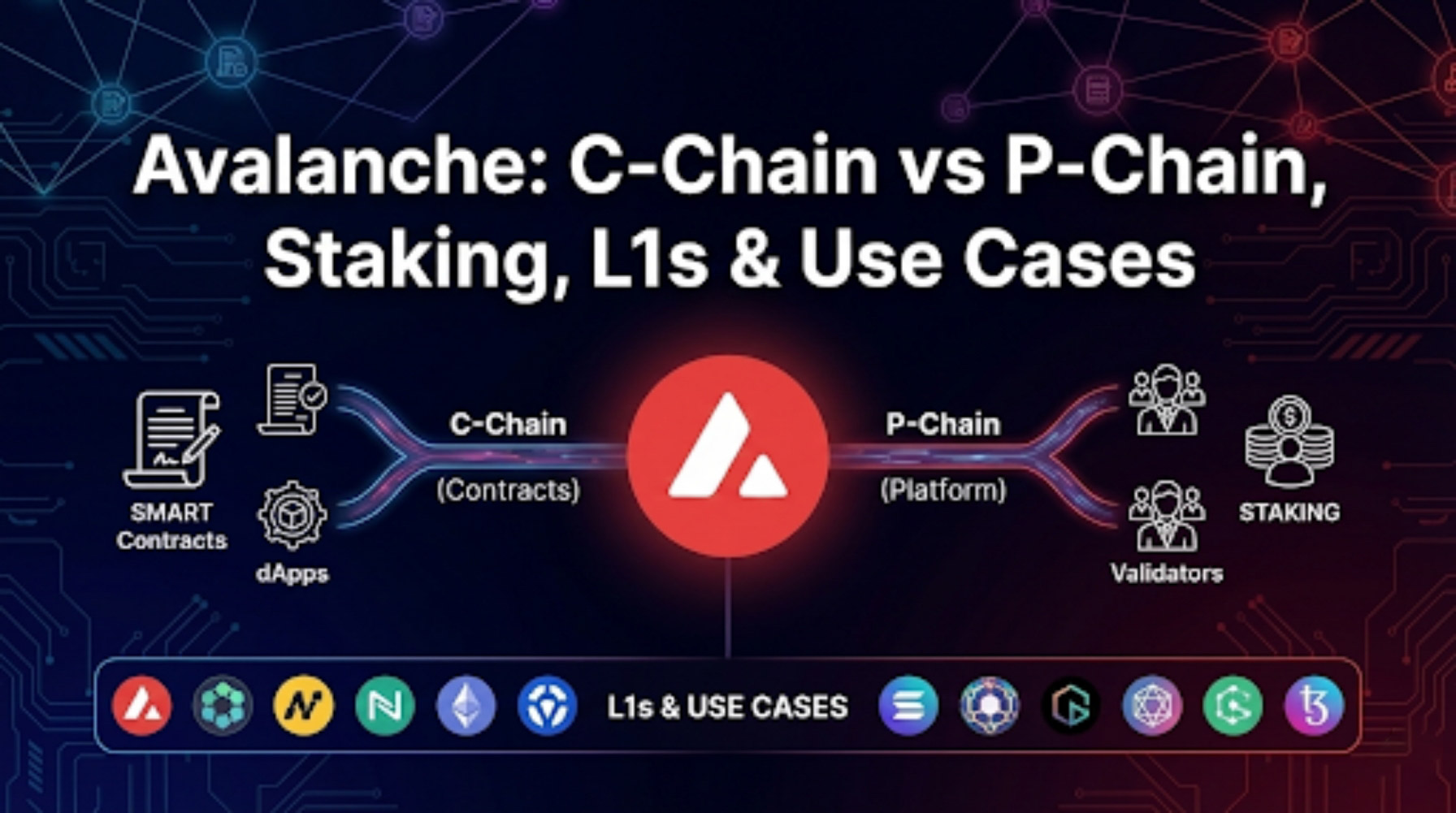
Avalanche (AVAX) is one of the most established “high-throughput” Layer-1 networks in crypto, best known for fast finality, EVM compatibility, and an architecture designed to scale horizontally through custom networks (now branded as Avalanche L1s). If you’ve ever used an Avalanche DeFi app, bridged tokens to C-Chain, or considered staking AVAX on the P-Chain, this guide breaks down what’s actually happening under the hood—without the hype.
Table Of Content
- What is Avalanche (AVAX)?
- Avalanche in 60 seconds (quick facts)
- How Avalanche reaches consensus (and why “finality” matters)
- Understanding Avalanche’s three core chains: X-Chain, P-Chain, C-Chain
- C-Chain (Contract Chain)
- P-Chain (Platform Chain)
- X-Chain (Exchange Chain)
- Avalanche L1s (formerly “Subnets”): why this matters in 2025+
- What is AVAX used for?
- How staking works on Avalanche (Validate vs Delegate)
- 1) Validating (running a node)
- 2) Delegating (staking without running a node)
- Staking durations and practical constraints
- Avalanche DeFi and ecosystem: what people actually use it for
- How to buy and hold AVAX (the safe, practical route)
- Key risks and what to watch before making decisions
- Bottom line
- Sources
Important: This article is educational and not investment advice. Cryptocurrency investments are subject to market risk.
What is Avalanche (AVAX)?
Avalanche is a smart contract platform built to support decentralized applications, token issuance, and custom blockchain networks. Its goal is simple: deliver a developer-friendly environment (EVM on C-Chain) while keeping transaction finality fast and fees predictable compared with older, congested networks.
Instead of forcing every app to compete for the same blockspace forever, Avalanche pushes a “multi-network” approach: the primary network provides core infrastructure, while teams can deploy dedicated Avalanche L1 networks (formerly called Subnets) tuned for specific use cases such as gaming, DeFi, or enterprise workflows.
Avalanche in 60 seconds (quick facts)
- Token: AVAX (used for fees, staking, and network operations)
- Supply model: Capped maximum supply (up to 720 million AVAX)
- Fee model: Network fees are paid in AVAX; fees are burned
- Smart contracts: EVM on C-Chain (most dApps live here)
- Staking / validator coordination: Primarily on P-Chain
- Asset transfers / native tokens: Often associated with X-Chain
How Avalanche reaches consensus (and why “finality” matters)
Every blockchain needs a way for nodes to agree on the valid state of the ledger. Avalanche’s primary network uses a family of consensus mechanisms typically discussed under “Avalanche consensus,” and for linear chains, the protocol is commonly described as Snowman. In practical terms, this design emphasizes:
- Fast, irreversible confirmations: finality in very short time windows (rather than waiting many blocks)
- High throughput: supporting many transactions without turning blockspace into a constant auction
- Energy efficiency: no proof-of-work mining
For users, finality is not just a buzzword. It affects exchange deposits, bridge safety assumptions, and how “safe” a confirmation feels for high-value transfers.
Understanding Avalanche’s three core chains: X-Chain, P-Chain, C-Chain
Avalanche’s primary network is often explained through its three-chain structure. You don’t need to memorize every detail, but knowing what each chain is “for” helps you avoid common mistakes (like sending funds to the wrong address format).
C-Chain (Contract Chain)
C-Chain is where most users spend their time. It runs the Ethereum Virtual Machine (EVM), meaning Solidity smart contracts, EVM wallets, and many Ethereum-style tools can work here. If you’ve used MetaMask on Avalanche, you were using C-Chain.
P-Chain (Platform Chain)
P-Chain coordinates validators and staking. It’s used for validator/delegator operations and historically managed Subnets (now Avalanche L1s). If you stake AVAX, you typically interact with P-Chain balances and P-Chain addresses.
X-Chain (Exchange Chain)
X-Chain is associated with asset transfers and creating native assets. Many users never interact directly with X-Chain for DeFi, but it exists as part of the broader design and uses a different address format than C-Chain.
Tip: If you’re moving funds between chains (C ↔ P, etc.), do it only through reputable, official tooling and double-check address formats. For self-custody best practices, see our Ultimate Crypto Security Guide.
Avalanche L1s (formerly “Subnets”): why this matters in 2025+
Avalanche previously popularized the term Subnet—a way for teams to launch their own customizable networks. More recently, Avalanche has been branding these as Avalanche L1s, emphasizing that these networks can operate with greater sovereignty than typical “rollups.”
For builders and institutions, the pitch is straightforward:
- Custom rules and economics: token models, gas policies, validator sets, and compliance controls can be designed around a specific product.
- Dedicated performance: apps aren’t constantly competing with every other app on the same chain for blockspace.
- App-specific scaling: a game or RWA platform can scale without waiting for a single global chain to upgrade.
This is also why Avalanche keeps showing up in “institutional infrastructure” conversations: dedicated networks can be easier to tailor for real-world constraints while still benefiting from a known developer ecosystem.
What is AVAX used for?
AVAX is the native token that powers the Avalanche ecosystem. Its primary roles include:
- Paying network fees: transactions and smart contract execution are paid in AVAX.
- Staking and security: validators (and delegators) stake AVAX to help secure the network.
- Network operations: AVAX is a resource for participating in and operating the ecosystem.
Avalanche is also known for burning transaction fees, which can partially offset issuance over time—though the net effect depends on network usage and issuance schedules.
How staking works on Avalanche (Validate vs Delegate)
Staking on Avalanche is generally explained in two paths:
1) Validating (running a node)
Validators run infrastructure, participate in consensus, and earn rewards if they meet uptime and protocol rules. On Avalanche mainnet, the documented minimum stake to become a validator is 2,000 AVAX.
2) Delegating (staking without running a node)
Delegators don’t run a validator node. Instead, they delegate AVAX to an existing validator and receive rewards minus the validator’s delegation fee. On Avalanche mainnet, the documented minimum to delegate is 25 AVAX.
Staking durations and practical constraints
Staking isn’t “instant withdraw” by default. The network documentation describes staking windows typically ranging from two weeks up to one year, depending on whether you validate or delegate. That means your AVAX may be locked for the duration you choose.
Risk note: Staking introduces operational risks (validator uptime, correct setup, lockup liquidity). If your priority is safety, start with the basics: best cold wallets and secure wallet hygiene.
If you’re comparing yield options across ecosystems, you may also like our overview of staking and yield strategies: Crypto Passive Income Guide (2026).
Avalanche DeFi and ecosystem: what people actually use it for
Avalanche has built a long-running DeFi footprint, and it remains a common destination for EVM users who want lower latency and a different liquidity landscape than Ethereum mainnet. Typical use cases include:
- DeFi trading and lending: DEXs, lending markets, yield vaults, and stablecoin strategies.
- Token launches and on-chain apps: EVM-based tooling simplifies deployments for teams already familiar with Ethereum.
- Custom networks (Avalanche L1s): teams building app-specific chains to control costs and performance.
For a broader view of where DeFi may be heading, see: DeFi Market 2026: Institutional Breakout.
How to buy and hold AVAX (the safe, practical route)
Most users buy AVAX on a centralized exchange and then move it to a wallet for self-custody. If you’re new to exchanges, start here: Best Crypto Exchanges (2026): Comparison & Reviews.
For storage, you typically have three options:
- Software wallet: convenient for daily use (but higher device risk).
- Hardware wallet (recommended for long-term): reduces exposure to malware and phishing.
- Exchange custody: simplest, but you rely on the platform’s security and policies.
Security reminder: Avalanche users are often targeted by fake airdrops, malicious “bridge” clones, and wallet-drainer approvals. If you’ll use DeFi, learn how approvals and signing risks work: Ultimate Crypto Security Guide.
Key risks and what to watch before making decisions
Avalanche is an established project, but no network is risk-free. Here are the real factors that matter:
- Ecosystem competition: EVM chains compete aggressively for liquidity and developers. Narratives can rotate quickly.
- Liquidity fragmentation: multi-network designs can create multiple liquidity pools across environments, complicating UX.
- Staking lockups: delegation/validation periods can reduce flexibility during volatile markets.
- Smart contract risk: the biggest losses in crypto often come from app-level exploits, not L1 consensus failures.
For investors who incorporate charts into decision-making, consider reading our Crypto Technical Analysis Guide to avoid common mistakes like chasing breakouts without context.
Bottom line
Avalanche remains one of the most practical EVM ecosystems for users who care about speed, smoother on-chain UX, and a network architecture built to support dedicated application networks (Avalanche L1s). If you’re evaluating AVAX, focus less on slogans and more on fundamentals: where activity is happening (C-Chain vs P-Chain), how staking lockups affect your risk profile, and whether Avalanche’s multi-network model fits the next wave of app design.
Reminder: Cryptocurrency investments are subject to market risk.
Sources
- Avalanche (AVAX) Support — What are the differences between the X, P, and C-Chains?
- Avalanche Builder Hub — Snowman Consensus
- Avalanche Builder Hub — How to Stake
- Avalanche (avax.network) — AVAX Token
- Avalanche Builder Hub — Etna changes (Subnets are now called L1s)