





Is Kraken About to Become Crypto’s First $100B “Hectocorn”? Inside the $20B IPO Play
Kraken IPO 2026 valuation analysis showing path from $20B to $100B hectocorn statusThe Asymmetric Bet on Digital Finance In the unfolding narrative of 2026, the global financial ecosystem is...

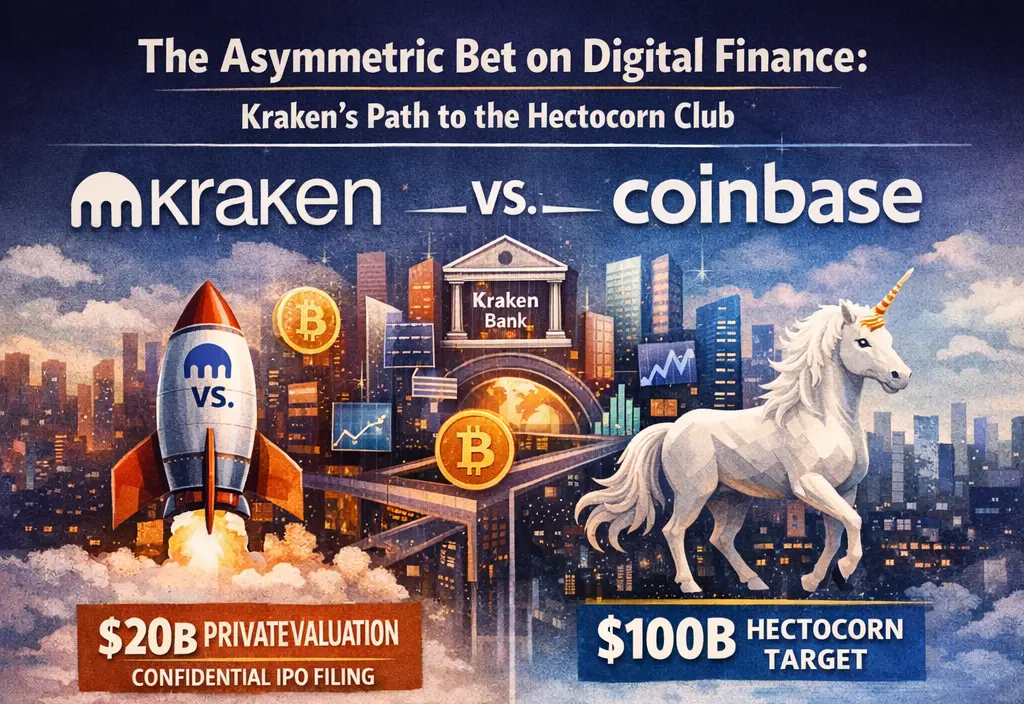
Kraken IPO 2026 valuation analysis showing path from $20B to $100B hectocorn statusThe Asymmetric Bet on Digital Finance
In the unfolding narrative of 2026, the global financial ecosystem is witnessing a convergence event of historic magnitude. The digital asset economy, once a volatile frontier of speculative experimentation, has hardened into a pillar of modern finance, driven by regulatory clarity, institutional adoption, and a resurgence in global liquidity. At the epicenter of this transformation stands Kraken, a venue that has evolved from a simple Bitcoin exchange founded in a San Francisco basement into a vertically integrated financial fortress. As of January 2026, Kraken has confidentially filed for an Initial Public Offering (IPO) with the U.S. Securities and Exchange Commission (SEC), following a strategic $800 million capital raise that solidified its private valuation at $20 billion.
Table Of Content
- Kraken IPO 2026 valuation analysis showing path from $20B to $100B hectocorn statusThe Asymmetric Bet on Digital Finance
- The Macro-Financial Landscape of 2026 – A Perfect Storm for Liquidity
- The “Mid-Cycle Acceleration” and Risk-On Sentiment
- The IPO Renaissance: The Year of the Hectocorn
- The Crypto Market Cycle: Institutional Maturity
- Kraken’s Corporate Metamorphosis: Financials and Leadership
- From Founder-Led to Institutional Grade – The Sethi Era
- Revenue Velocity and Unit Economics
- The $800 Million Pre-IPO War Chest
- The Strategic Moat – Regulatory Architecture and the SPDI Charter
- The SEC Dismissal: A “With Prejudice” Victory
- The Wyoming SPDI: The First Crypto Bank
- Redefining Staking: The Post-Settlement Model
- Product Ecosystem – Building the Financial Super-App
- Derivatives Dominance: The NinjaTrader Acquisition
- Ink: The Layer-2 Infrastructure Play
- xStocks: The Attack on TradFi
- Kraken Institutional: The Prime Brokerage War
- Competitive Analysis – The Duopoly Dynamics
- Kraken vs. Coinbase
- The Binance Factor
- Valuation Modeling – The Path to $100 Billion
- The “Hectocorn” Math
- The Institutional Flow Catalyst
- Risks and Headwinds
- Execution Risk in a Crowded Market
- The “Commoditization” of Crypto Trading
- Macro Reversal
- Conclusion – The Convergent Trade
This report investigates the central question captivating Wall Street and Silicon Valley alike: Can Kraken bridge the chasm between its current $20 billion mark and the mythical $100 billion “Hectocorn” status? While such a valuation leap implying a 5x multiple expansion may seem aggressive, a nuanced analysis of Kraken’s regulatory victories, particularly the “with prejudice” dismissal of the SEC’s lawsuit in March 2025, and its aggressive expansion into banking and derivatives suggests a pathway exists.
The “Hectocorn” nomenclature, reserved for private companies exceeding $100 billion in value, has typically been the domain of generational tech disruptors like SpaceX, OpenAI, and ByteDance. For a cryptocurrency exchange to join these ranks requires more than just rising Bitcoin prices; it demands a fundamental re-rating of the business model from a transaction-based exchange to a comprehensive financial infrastructure provider. This report argues that Kraken’s unique “crypto bank” charter in Wyoming, combined with its acquisition of NinjaTrader and launch of the “Ink” Layer-2 network, provides the structural foundation for exactly such a re-rating.
We will explore the macroeconomic tailwinds of 2026, dissect Kraken’s fortified balance sheet, contrast its regulatory standing against arch-rival Coinbase, and model the valuation scenarios that could propel the firm into the hectocorn club.
The Macro-Financial Landscape of 2026 – A Perfect Storm for Liquidity
The “Mid-Cycle Acceleration” and Risk-On Sentiment
To understand Kraken’s IPO timing, one must first contextualize the broader economic environment of early 2026. Investment banking giants like Goldman Sachs have characterized the period as a “mid-cycle acceleration,” defined by U.S. GDP growth projections of 2.7% and a Federal Reserve that has pivoted toward interest rate cuts. This monetary easing is historically a potent catalyst for risk assets, reducing the cost of capital for growth companies and driving investors further out on the risk curve in search of yield.
In this environment, the correlation between global liquidity expansion and crypto asset valuations remains high. As central banks inject liquidity, the “denominator effect” lifts the prices of scarce assets like Bitcoin, which in turn drives trading volumes the lifeblood of Kraken’s revenue model. Furthermore, the stabilization of inflation has allowed institutional capital, previously hiding in money market funds, to redeploy into high-beta equities and digital assets.
The IPO Renaissance: The Year of the Hectocorn
The IPO market, dormant for much of 2023 and 2024, has roared back to life in 2026, creating a favorable psychological backdrop for Kraken’s debut. The pipeline is dominated by mega-cap technology firms. OpenAI, valued at $500 billion, and SpaceX, reaching toward $800 billion, are preparing for liquidity events that are reshaping investor expectations for scale.
This “listing stampede” creates a thematic basket for investors. Kraken is not listing in isolation; it is part of a cohort of mature crypto infrastructure firms, including Circle, BitGo, and Chainalysis, that are transitioning to public markets. This clustering effect is crucial. It allows institutional asset managers to construct diversified “digital infrastructure” allocations, moving beyond merely holding spot Bitcoin ETFs to owning the equity of the regulated rails that move the assets.
The Crypto Market Cycle: Institutional Maturity
By 2026, the “crypto winter” of 2022 is a distant memory, replaced by a market structure defined by ETF inflows and sovereign adoption. The approval and success of Spot Bitcoin and Ethereum ETFs in the U.S. have permanently integrated crypto into the Registered Investment Advisor (RIA) workflow. However, a critical bottleneck has emerged: custody concentration. With Coinbase acting as the custodian for nearly 90% of ETF assets in 2024-2025, risk managers are desperate for diversification. This structural demand for a “second reliable custodian” creates a massive, immediate total addressable market (TAM) for Kraken, which we will explore in the regulatory section.
Kraken’s Corporate Metamorphosis: Financials and Leadership
From Founder-Led to Institutional Grade – The Sethi Era
The transition of leadership at Kraken marks a pivotal maturation point. While co-founder Jesse Powell built the cultural and security foundations of the exchange famously prioritizing self-custody and libertarian values the appointment of Arjun Sethi as co-CEO in October 2024 signaled a shift toward Wall Street integration. Sethi, a co-founder of Tribe Capital and an early investor in Kraken, brings a venture capitalist’s discipline to the firm’s unit economics and a network deeply embedded in Silicon Valley’s elite “PayPal Mafia” circles (having invested in xAI and Rippling).
Sethi’s strategy has been characterized by “disciplined aggression.” In interviews, he has explicitly rejected the “FOMO” (Fear Of Missing Out) approach to IPOs, stating, “If we were a part of the pack of companies that have FOMO to go public, then we would have already filed”. This patience has allowed Kraken to clean up its cap table, settle regulatory disputes, and bolster its balance sheet before inviting public scrutiny.
Revenue Velocity and Unit Economics
Kraken’s financial performance in the lead-up to its IPO filing demonstrates robust growth dynamics.
- 2024 Revenue: The company generated approximately $1.5 billion in revenue, capitalizing on the initial resurgence of retail trading interest.
- 2025 Performance: Estimates for full-year 2025 revenue range between $2.5 billion and $2.8 billion, representing a year-over-year growth rate exceeding 65%. In Q1 2025 alone, Kraken reported $472 million in revenue, a 19% increase year-over-year even before the full effect of the bull market took hold.
- Profitability: Unlike many hyper-growth tech stocks, Kraken is profitable. Adjusted EBITDA for 2024 was reported at $421 million. By Q3 2025, quarterly Adjusted EBITDA hit $178.6 million, implying an annualized run rate approaching $750 million.
This profitability profile is critical for the “Hectocorn” thesis. It suggests that Kraken is not burning cash to acquire users but is scaling with operating leverage. As trading volumes increase, the marginal cost of processing those trades decreases, causing net income margins to expand faster than revenue a phenomenon known as “operating leverage” that public market investors reward with premium multiples.
The $800 Million Pre-IPO War Chest
In November 2025, Kraken closed an $800 million funding round at a $20 billion valuation. This round was notable not just for the size, but for the participants. Citadel Securities, a Titan of traditional market making, invested heavily. This strategic alignment suggests a future integration of Kraken’s crypto liquidity with Citadel’s massive order flow capabilities, potentially bridging the gap between traditional high-frequency trading (HFT) and crypto markets.
The Strategic Moat – Regulatory Architecture and the SPDI Charter
The SEC Dismissal: A “With Prejudice” Victory
The single most significant value catalyst for Kraken in 2026 was the formal dismissal of the SEC’s enforcement action in March 2025. Crucially, this dismissal was “with prejudice,” meaning the SEC cannot refile the same charges.
This legal outcome differentiates Kraken sharply from Coinbase. While Coinbase continues to litigate certain aspects of its business, Kraken has effectively secured a regulatory ceasefire. The “Wells Notice discount” a valuation penalty applied to crypto stocks due to regulatory uncertainty—has been removed for Kraken. Institutional investment committees, which previously barred allocation to Kraken due to “active litigation,” can now greenlight the stock. This opens the door to pension funds, sovereign wealth funds, and endowments that require clean regulatory bills of health.
The Wyoming SPDI: The First Crypto Bank
While the SEC victory removed a negative, the Wyoming Special Purpose Depository Institution (SPDI) charter adds a massive positive structural advantage. Kraken was the first digital asset company to receive a U.S. bank charter, approving the formation of “Kraken Bank”.
The SPDI charter is not merely a license; it is a structural moat.
Direct Custody: Unlike competitors who must partner with third-party commercial banks to hold customer U.S. dollars (introducing counterparty risk), Kraken Bank can custody assets directly.
100% Reserve Requirement: The SPDI charter mandates that the bank hold 100% of its deposits in liquid assets (cash or treasuries). It cannot lend out customer deposits for high-risk ventures. This “full reserve” model is the antithesis of the fractional reserve banking model that failed at Silicon Valley Bank and the fraudulent commingling that destroyed FTX.
Qualified Custodian Status: Under the SPDI rules, Kraken acts as a “Qualified Custodian”. This is the “golden ticket” for institutional asset gathering. SEC rules generally require registered investment advisors (RIAs) to hold client assets with a Qualified Custodian. By meeting this definition internally, Kraken can service the massive influx of RIA capital into crypto without relying on third parties.
Redefining Staking: The Post-Settlement Model
In 2023, Kraken settled with the SEC regarding its legacy staking product, paying a $30 million fine. However, rather than abandoning the business, Kraken re-architected it. The new staking model is transparent and technical, positioning Kraken as a service provider connecting users to the protocol rather than a “yield product” manager. This distinction has allowed Kraken to continue generating high-margin staking revenue while remaining compliant, a nuance that the market is only beginning to appreciate.
Product Ecosystem – Building the Financial Super-App
To justify a $100 billion valuation, Kraken must demonstrate that it is more than just a spot exchange dependent on Bitcoin’s price cycles. The company has executed a “Super-App” strategy through aggressive acquisitions and product launches.
Derivatives Dominance: The NinjaTrader Acquisition
In a move that stunned the fintech world, Kraken acquired NinjaTrader, a U.S.-based retail futures brokerage, for approximately $1.5 billion. This acquisition provided Kraken with an immediate, licensed foothold in the U.S. derivatives market.
In the global crypto market, derivatives (futures and perpetual swaps) volumes typically dwarf spot volumes by a factor of 3 to 1. However, in the U.S., regulatory barriers have kept this market fragmented. With NinjaTrader’s licenses (Futures Commission Merchant) and Kraken’s crypto liquidity, the combined entity can offer a seamless “capital efficient” trading experience where a user can cross-margin their Bitcoin holdings to trade S&P 500 futures, or vice versa. This capital efficiency is the “holy grail” for active traders and provides a sticky, high-volume revenue stream that is less correlated to crypto bull runs.
Ink: The Layer-2 Infrastructure Play
Mirroring Coinbase’s success with its “Base” blockchain, Kraken launched “Ink,” a Layer-2 (L2) network built on the Optimism Superchain stack. Ink represents Kraken’s strategy to monetize the decentralized finance (DeFi) ecosystem.
- Sequencer Revenue: As the operator of the Ink chain, Kraken collects fees from every transaction processed on the network. If Ink achieves even a fraction of Base’s adoption, this could represent hundreds of millions in high-margin annual revenue.
- DeFi Bridge: Ink serves as a trusted bridge for Kraken’s 5+ million funded accounts to access DeFi yields and applications without leaving the Kraken ecosystem’s safety perimeter. This “walled garden” approach captures value from users who want to explore Web3 but fear the technical complexity of self-custody wallets.
xStocks: The Attack on TradFi
Kraken has not been content to stay in its lane. The launch of “xStocks” (tokenized stocks) allows users to trade fractionalized shares of U.S. equities like NVIDIA or Tesla alongside their crypto holdings. This product targets the “Robinhood demographic” young, active traders who view asset classes as interchangeable. By offering 24/7 trading on tokenized equities (a feature traditional markets cannot match), Kraken is positioning itself to steal market share from traditional discount brokerages.
Kraken Institutional: The Prime Brokerage War
The institutional arm of Kraken has been aggressively expanded to compete with Coinbase Prime. Leveraging its “Qualified Custodian” status and the deep liquidity provided by partners like Citadel, Kraken is winning mandates from hedge funds and family offices. The 2026 market structure demands “dual-custody” arrangements to mitigate risk; Kraken is effectively the default “second option” for every major institution onboarding to crypto, guaranteeing a floor of institutional market share.
Competitive Analysis – The Duopoly Dynamics
Kraken vs. Coinbase
The rivalry between Kraken and Coinbase is the defining dynamic of the U.S. crypto sector.
- Valuation Gap: Coinbase trades at a public market cap fluctuating between $65 billion and $85 billion. Kraken’s private valuation is $20 billion. This massive delta exists despite Kraken having comparable tenure, superior security history (no major hacks), and a banking charter that Coinbase lacks.
- Revenue Quality: While Coinbase relies heavily on custodial fees from ETFs (a race-to-the-bottom margin business), Kraken’s revenue mix is heavily weighted toward high-frequency trading fees and derivatives, which tend to be more resilient.
- Geographic Diversification: Kraken is the dominant exchange for Euro (EUR) trading volume, providing a natural hedge against U.S. regulatory stagnation or dollar volatility. Coinbase is far more U.S.-centric.
The Binance Factor
Globally, Binance remains the volume leader, but for U.S. institutions, Binance is “un-investable” due to its regulatory entanglements. This effectively leaves the premium U.S. institutional market as a duopoly between Coinbase and Kraken. In duopolies, the “number two” player often commands a significant valuation premium as the necessary alternative.
Valuation Modeling – The Path to $100 Billion
How does a company valued at $20 billion reach $100 billion? It requires a perfect alignment of multiple expansion and earnings growth.
The “Hectocorn” Math
To achieve a $100 billion valuation, Kraken would likely need to trade at approximately 20-25x its forward EBITDA.
- Scenario A: Multiple Expansion. If the 2026 bull market enters a mania phase, fintech multiples could expand to 30x or 40x (levels seen in 2021). At 30x, Kraken would need ~$3.3 billion in EBITDA.
- Scenario B: Revenue Explosion. If Kraken’s revenue grows from ~$2.5 billion (2025 est.) to ~$6 billion in 2027 driven by the derivatives integration and Ink adoption and maintains a 30% margin, it would generate $1.8 billion in EBITDA. At a generous 30x multiple, this yields a ~$54 billion valuation.
- The “Bank” Premium. If the market prices Kraken not as an exchange but as a high-growth bank or fintech platform (like Adyen or Stripe), the valuation ceiling lifts. Banks are valued on assets; tech platforms on growth. Kraken is both.
The Institutional Flow Catalyst
The “wild card” in this valuation model is the custody of real-world assets (RWAs). If Kraken can capture a significant percentage of the tokenized asset market (projected by some analysts to reach trillions by 2030), the assets under custody (AUC) on its platform could explode from ~$60 billion to ~$500 billion. Even a small custody fee on that base creates a recurring revenue stream that warrants a massive valuation premium.
Risks and Headwinds
Execution Risk in a Crowded Market
The transition to public markets brings quarterly scrutiny. Kraken must flawlessly integrate its acquisitions (NinjaTrader) and scale its banking operations. Any technical failure or delay in product rollouts will be punished by algorithmic traders.
The “Commoditization” of Crypto Trading
Spot trading fees are trending toward zero. Kraken’s reliance on trading revenue (maker/taker fees) is a long-term vulnerability. The pivot to “Ink” and “Kraken Bank” is an attempt to escape this trap, but success is not guaranteed. If fee compression accelerates before these new revenue streams mature, margins will compress.
Macro Reversal
The “mid-cycle acceleration” thesis assumes no recession. If the U.S. economy enters a hard landing in late 2026, risk assets will be liquidated first. A collapse in crypto prices would decimate trading volumes and asset values, crushing the IPO thesis.
Conclusion – The Convergent Trade
Kraken’s upcoming IPO is more than just a listing; it is a referendum on the future of crypto market structure. By securing a banking charter, dismissing SEC litigation, and building a vertical stack from Layer-2 to derivatives, Kraken has engineered a business model that is fundamentally more robust than the spot exchanges of the previous cycle.
While the leap to a $100 billion “Hectocorn” valuation is ambitious, it is not mathematically impossible in the liquidity-rich environment of 2026. If Kraken can successfully frame itself as the “Institutional Bank of the Crypto Economy” a safe, regulated, and comprehensive platform institutional capital looking for an alternative to Coinbase will bid the stock up aggressively. The arbitrage between the private $20 billion mark and the public market potential represents one of the most asymmetric opportunities in the 2026 fintech landscape.


