





Orion Protocol to Lumia: The 2026 Guide to DeFi’s Liquidity Aggregator
Orion Protocol has long been a name synonymous with the ambitious quest to unify the fragmented landscape of digital asset liquidity. As we navigate the complex financial ecosystem of 2026, the...

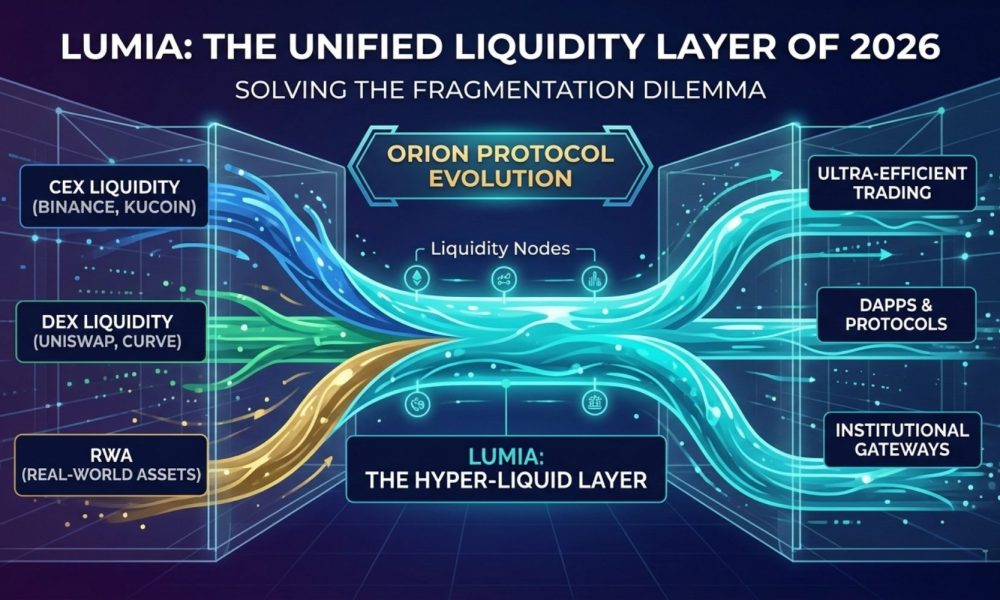
Orion Protocol has long been a name synonymous with the ambitious quest to unify the fragmented landscape of digital asset liquidity. As we navigate the complex financial ecosystem of 2026, the project’s evolution into Lumia marks a pivotal moment in decentralized finance (DeFi). For years, traders and institutional players struggled with the “liquidity silo” problem—where assets were trapped across disparate centralized exchanges (CEXs) and decentralized exchanges (DEXs), leading to slippage, inefficiency, and missed opportunities. The foundational vision of the Orion Protocol was to build a single point of entry to the entire crypto market. Today, that vision has matured into a sophisticated “Hyper-Liquid Layer” known as Lumia, providing the essential plumbing for the next generation of on-chain finance.
Table Of Content
Evolution of Orion Protocol into the Lumia Infrastructure
To understand where we are in 2026, one must analyze the strategic pivot that transitioned the Orion Protocol from a suite of trading tools into a foundational liquidity layer. Originally, the protocol gained notoriety for its “Terminal,” which allowed users to trade across major exchanges like Binance and KuCoin without leaving their non-custodial wallets. However, as the industry shifted toward Layer 2 solutions and modular blockchain architectures, the team realized that being a mere aggregator was not enough. The market demanded a deeper integration of liquidity that could serve not just retail traders, but other protocols, dApps, and institutional gateways.
The transition to Lumia represented a shift from an application-level service to an infrastructure-level powerhouse. By leveraging the initial technology stack of the Orion Protocol, Lumia has established itself as the first “Hyper-Liquid” Layer 2. This network serves as a bridge, connecting the massive liquidity pools of centralized entities with the transparency and security of decentralized networks. For an analyst, the brilliance of this transition lies in the “Liquidity Nodes.” These nodes are responsible for fetching the best prices from every corner of the market, ensuring that whether a user is swapping a popular blue-chip asset or a niche Real-World Asset (RWA), they receive the most efficient execution possible.
Understanding the Orion Protocol Legacy within Lumia’s Aggregator Layer
The core technical achievement of the Orion Protocol was its ability to aggregate order books without requiring users to surrender their private keys. In 2026, this “DeFi-CEX” hybrid model has become the industry standard for secure trading. Lumia has expanded this by introducing a zkEVM-based environment that allows for near-instant finality and negligible gas fees. This is a far cry from the early days of Ethereum-based trading, where high costs often neutralized the benefits of finding a better price.
By integrating the legacy code of the Orion Protocol into a more robust L2 framework, the developers have solved the “fragmentation dilemma.” In the current market, liquidity is no longer just about having many buyers and sellers; it is about the velocity and accessibility of that liquidity. Lumia acts as a sophisticated router. When a trade is initiated, the protocol doesn’t just look at one pool; it scans global CEX order books and local DEX AMMs simultaneously, splitting the order to minimize price impact. This is the ultimate realization of the liquidity aggregator layer that was promised years ago.
Orion Protocol Role of $LUMIA and the Tokenomic Shift
No discussion of the Orion Protocol journey is complete without addressing the transition from the $ORN token to the $LUMIA token. This was not merely a rebranding exercise but a fundamental overhaul of the project’s economic engine. In the 2026 landscape, the $LUMIA token serves multiple critical functions: it secures the network through staking in Liquidity Nodes, acts as the primary medium for governance, and provides a mechanism for fee redistribution to active participants.
The tokenomics were redesigned to incentivize long-term sustainability rather than short-term speculation. By burning a portion of the transaction fees and rewarding node operators who provide consistent, high-quality liquidity, the protocol has created a “flywheel effect.” As more volume flows through the Lumia aggregator, the value proposition for token holders strengthens, which in turn attracts more liquidity providers. This circular economy is what has allowed the project to remain relevant in an era where many early DeFi protocols have faded into obscurity.
Institutional Adoption and the Rise of Real-World Assets (RWAs)
In 2026, the frontier of blockchain is undoubtedly the tokenization of Real-World Assets. This is where the Orion Protocol heritage shines brightest. Institutional investors require deep, stable liquidity to trade tokenized versions of gold, real estate, or government bonds. Lumia’s aggregator layer is uniquely positioned to handle these assets because it can tap into the liquidity of traditional financial markets that have been bridged onto the blockchain.
The “trustless” nature of the protocol’s architecture provides the regulatory comfort that institutions demand. Because the aggregator layer does not take custody of funds, it bypasses many of the hurdles that centralized brokerage firms face. Analysts have noted that Lumia’s ability to provide a “Single Source of Truth” for asset pricing across different chains has made it the preferred backend for several major neo-banks and institutional trading desks. The protocol has essentially become the “Nasdaq of the On-Chain World,” proving that the original goals of the Orion Protocol were not just visionary but prescient.
Future of Liquidity in a Post-Fragmentation Era
As we look toward the late 2020s, the legacy of the Orion Protocol serves as a masterclass in adaptation. What began as an ambitious attempt to unify exchange order books has transformed into a critical piece of global financial infrastructure. Lumia has successfully navigated the transition from a niche DeFi tool to a ubiquitous liquidity layer, proving that the future of finance is not about choosing between centralized and decentralized systems, but about seamlessly integrating the two.
For journalists and market analysts, the takeaway is clear: the success of this protocol is rooted in its focus on solving the most fundamental problem in any market—liquidity. By building a layer that is faster, cheaper, and more connected than its predecessors, Lumia has ensured that it remains at the heart of the digital asset economy. As more assets move on-chain, the demand for a hyper-liquid aggregator will only grow, cementing the protocol’s place in the history of financial innovation.


