

5 Assets That Could Outperform Bitcoin in 2026 (Risk-First Analysis)
Bitcoin is the benchmark asset of crypto. So when someone says “this will outperform BTC,” what they’re really saying is: I’m taking more risk in exchange for a chance at higher returns. That trade...

Bitcoin is the benchmark asset of crypto. So when someone says “this will outperform BTC,” what they’re really saying is: I’m taking more risk in exchange for a chance at higher returns.
Table Of Content
- Key takeaways (read this before anything else)
- What “outperforming Bitcoin” actually means in 2026
- Checklist 1: A simple benchmark you can actually follow
- The 5 assets that could outperform BTC in 2026
- 1) Ethereum (ETH): the settlement layer and on-chain economy beta
- 2) Solana (SOL): high-throughput “single-chain” growth beta
- 3) Chainlink (LINK): the infrastructure layer for tokenization and cross-chain finance
- 4) Ondo (ONDO): a higher-beta bet on compliant on-chain financial products
- 5) Render (RENDER): AI/compute demand meets crypto incentive design
- Checklist 2: Position sizing and risk management (the part most people skip)
- Checklist 3: Due diligence before buying any “BTC outperformer”
- Common mistakes that ruin “outperformance” plans
- Risks & red flags (read this twice)
- FAQ
- Can anything reliably outperform Bitcoin long-term?
- Is Ethereum “safer” than other altcoins?
- Why include both LINK and ONDO—aren’t they the same RWA trade?
- Is Solana only a meme/retail chain?
- How do I avoid buying the wrong token or a fake contract?
- Should I hold these on an exchange or in self-custody?
- Do I need technical analysis for this strategy?
- What’s the single best way to reduce risk while chasing outperformance?
- Conclusion
That trade can make sense in 2026 especially if market liquidity improves and capital rotates from the “store of value” trade into platforms and sectors. However, most investors lose money here for one simple reason: they chase narratives without a framework.
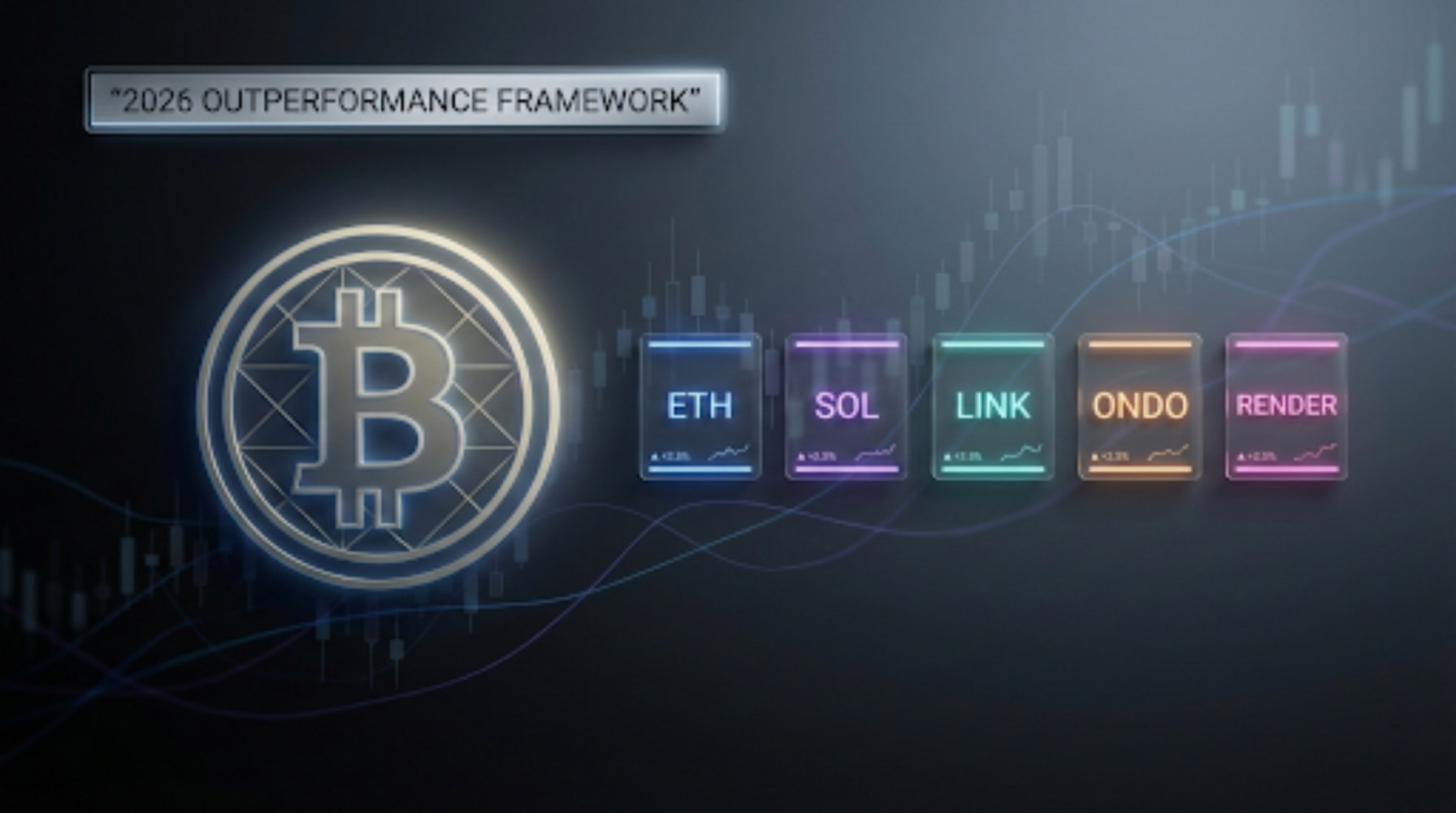
This update gives you a practical, risk-first framework (not hype, not price targets) to evaluate five assets that could outperform Bitcoin in 2026: Ethereum (ETH), Solana (SOL), Chainlink (LINK), Ondo (ONDO), and Render (RENDER). If you’re still getting comfortable with the basics, start with Crypto for Dummies (2026) first.
Key takeaways (read this before anything else)
- “Outperform Bitcoin” usually means “higher beta.” If it works, it can work fast. If it fails, it can fail brutally.
- Use a benchmark. You don’t need a price target—you need a plan for what “better than BTC” means for you.
- Prefer measurable catalysts. Adoption, fees/revenue, developer activity, liquidity, and regulatory clarity.
- Tokenomics matter more than opinions. Unlocks, emissions, and insider concentration can cap upside.
- Security is not optional. Read The Ultimate Crypto Security Guide (Self-Custody) before deploying real size.
What “outperforming Bitcoin” actually means in 2026
There are three clean ways to define outperformance. Pick one, or you’ll confuse yourself mid-cycle.
- Absolute return: The asset rises more than BTC in USD terms.
- Relative strength: The asset rises versus BTC (its BTC pair trends up), even if USD prices are choppy.
- Risk-adjusted return: The asset delivers better returns per unit of volatility than BTC (rare, but possible in specific windows).
Checklist 1: A simple benchmark you can actually follow
- Decide your “core vs satellite” split. For most people, BTC is the core, and everything else is a satellite.
- Define your time horizon. Weeks (trading), months (cycle positioning), or years (thesis investing).
- Choose 2–3 metrics you’ll track. Example: active users, fees/revenue, and token supply expansion/unlocks.
- Write your invalidation rule. What would make you exit even if the price is “promising”?
- Pre-commit to risk limits. Position sizing and maximum drawdown tolerance—before emotions show up.
If you trade around positions, make sure you understand structure and risk tools in The Crypto Technical Analysis Guide and read the safety section in DEX Trading Guide (2026).
The 5 assets that could outperform BTC in 2026
These picks are not “guaranteed winners.” They’re five high-signal exposures to themes that have clear catalysts you can track.
1) Ethereum (ETH): the settlement layer and on-chain economy beta
Why ETH can outperform: Ethereum tends to capture upside when the market pays for utility: DeFi, stablecoin settlement, tokenization, and app ecosystems. It’s also structurally positioned as the primary settlement layer for many rollups.
- What must go right: Continued scaling improvements, healthy rollup ecosystem growth, and sustained demand for blockspace/security.
- What to watch: Network fees (not just price), rollup activity, stablecoin settlement growth, and developer momentum.
- Main risks: Complex ecosystem risk (bridges, L2 fragmentation), smart contract tail risk, and shifting regulatory narratives.
ETH’s upside often comes with “system complexity.” If you don’t have a secure wallet setup yet, fix that first: How to Create a Crypto Wallet.
2) Solana (SOL): high-throughput “single-chain” growth beta
Why SOL can outperform: Solana tends to perform when consumer-grade crypto usage grows (trading, payments experiments, DePIN, and high-frequency apps). Its thesis is simple: speed and low friction can win adoption.
- What must go right: Reliability stays strong under load, developer growth continues, and real usage expands beyond short-lived speculation.
- What to watch: Active addresses/wallets, app retention, fee growth, and liquidity quality (not just volume spikes).
- Main risks: Congestion/event-driven instability, ecosystem concentration, and “hot money” cycles that reverse quickly.
3) Chainlink (LINK): the infrastructure layer for tokenization and cross-chain finance
Why LINK can outperform: If real-world asset (RWA) tokenization expands, the market needs reliable data, messaging, and interoperability. Chainlink is widely positioned as core infrastructure in that direction.
- What must go right: Institutional-grade integrations keep progressing and network usage converts into sustainable economics for the token.
- What to watch: Adoption by serious apps, cross-chain messaging usage, and tangible fee/revenue signals.
- Main risks: Slower-than-expected institutional adoption, competitive pressure, and valuation running ahead of fundamentals.
To understand why RWAs matter (and why stablecoins are the bridge), read Stablecoins & Global Finance (2026).
4) Ondo (ONDO): a higher-beta bet on compliant on-chain financial products
Why ONDO can outperform: If tokenized Treasuries, funds, and compliant on-chain products grow, “product-layer” winners can outperform infrastructure—because narratives shift from “rails” to “assets people actually hold.”
- What must go right: Product-market fit expands beyond a single product line, distribution grows, and compliance/regulatory posture remains resilient.
- What to watch: AUM growth, product expansion, counterparties/distribution, and on-chain usage quality.
- Main risks: Token supply dynamics (unlock schedules and concentration), regulatory friction, and dependency on institutional appetite.
Because this category touches regulation directly, keep your expectations grounded with SEC Crypto Regulation (2026) Guide.
5) Render (RENDER): AI/compute demand meets crypto incentive design
Why RENDER can outperform: When AI narratives drive real demand for compute, decentralized networks that broker GPU supply can catch powerful flows. Render is one of the cleaner “picks and shovels” exposures—if network usage grows in a measurable way.
- What must go right: Real customer demand increases, node supply scales without degrading quality, and the token is clearly tied to usage.
- What to watch: Usage growth, creator demand, and whether token economics align with real activity rather than incentives alone.
- Main risks: Narrative-led pumps, competition from centralized providers, and ecosystem/security risks around bridges and upgrades.
Checklist 2: Position sizing and risk management (the part most people skip)
- Keep BTC as your “survival asset.” If your alt basket fails, your portfolio shouldn’t implode.
- Cap single-asset exposure. High-beta assets should be sized so a 50% drawdown is survivable.
- Avoid leverage as a default. Leverage turns normal volatility into forced liquidation risk.
- Plan exits. Decide in advance what “enough” looks like for partial profit-taking.
- Secure custody early. Use the guidance in Best Cold Wallets (2025) — Hardware Wallet Reviews if you’re holding meaningful size.
Checklist 3: Due diligence before buying any “BTC outperformer”
- Verify you’re buying the real token. Fake tickers and cloned contracts are common—use How to Spot Fake Tokens (2026).
- Read tokenomics like a contract. Emissions, unlocks, and insider concentration can silently cap upside.
- Check liquidity quality. Thin books and fragmented venues create slippage and bad fills.
- Understand where the “value” comes from. Fees, real users, real demand—not just incentives.
- Map the risk surface. Bridges, upgrades, admin keys, and smart contract dependencies.
Common mistakes that ruin “outperformance” plans
- Confusing a good narrative with a good trade. Narratives move faster than fundamentals—and reverse faster too.
- Ignoring supply events. Unlocks and emissions can overwhelm demand even in bullish markets.
- Buying after a vertical move. If you can’t explain the catalyst beyond “it’s pumping,” you’re late.
- Trading on-chain without a safety system. If you’re using DEXs, follow the risk checklist in DEX Trading Guide (2026).
- Leaving serious holdings on exchanges. Self-custody basics are not optional: Ultimate Crypto Security Guide.
Risks & red flags (read this twice)
- Regulatory headlines can reprice assets overnight. Especially tokens perceived as “more security-like.”
- Smart contract and bridge risk is permanent. Higher yield and complexity often mean higher exploit risk.
- Liquidity can vanish when you need it most. Thin markets exaggerate drawdowns.
- “Too many catalysts” is a red flag. If everything is bullish and none of it is measurable, it’s marketing.
- Anything that pushes urgency or guarantees returns is noise. Treat it as a warning, not an opportunity.
FAQ
Can anything reliably outperform Bitcoin long-term?
Over long horizons, BTC has historically been a tough benchmark. Outperformance is usually cyclical—altcoins can beat BTC in specific windows, but they often underperform across full cycles.
Is Ethereum “safer” than other altcoins?
It can be lower risk than many smaller tokens due to liquidity and ecosystem maturity. However, it’s still a high-volatility asset with protocol and regulatory complexity.
Why include both LINK and ONDO—aren’t they the same RWA trade?
They’re related but not identical. LINK is closer to infrastructure; ONDO is closer to product/distribution. Infrastructure can be more resilient, while product bets can be higher beta.
Is Solana only a meme/retail chain?
That stereotype is incomplete. The real question is retention: does usage persist when speculation cools? Watch activity quality and app stickiness, not slogans.
How do I avoid buying the wrong token or a fake contract?
Use the verification checklist in How to Spot Fake Tokens (2026) and never rely on search results or random social links.
Should I hold these on an exchange or in self-custody?
If the position matters, self-custody is typically safer. Start with How to Create a Crypto Wallet and follow the full setup in Ultimate Crypto Security Guide.
Do I need technical analysis for this strategy?
You don’t need to be a chart wizard, but you do need risk awareness—entries, exits, and invalidation levels. Use The Crypto Technical Analysis Guide as a practical foundation.
What’s the single best way to reduce risk while chasing outperformance?
Keep BTC as the core, keep alt exposure sized, avoid leverage, and only buy assets where you can explain: (1) what drives demand, (2) what breaks the thesis, and (3) how you’ll manage the downside.
Conclusion
In 2026, the smarter way to hunt for “Bitcoin outperformers” is not prediction—it’s process. ETH and SOL represent platform beta; LINK and ONDO express the RWA thesis from two angles; RENDER is a higher-beta bet on decentralized compute demand. Any of them can outperform BTC in the right environment. Any of them can also underperform if liquidity tightens, regulation shifts, or tokenomics work against holders.
Informational only, not financial advice.