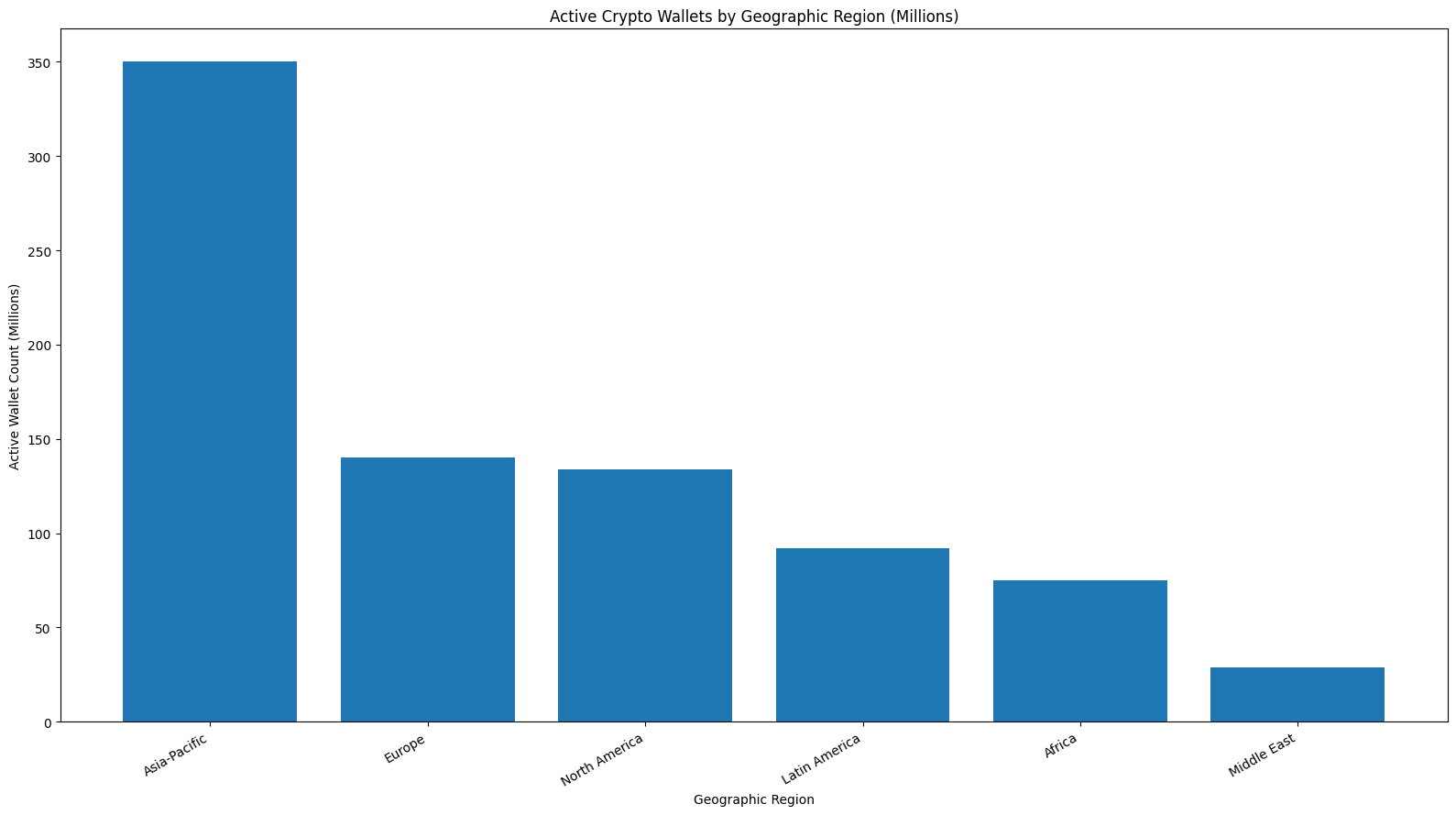
Futuristic illustration of DeFi wallets in 2026 showing MetaMask, Rabby Wallet, OneKey Pro, Tangem cards, Ethereum staking, MPC security, and ERC-4337 smart accounts in a multi-chain cityscape.The decentralized finance landscape of 2026 has reached a definitive maturity, characterized by the resolution of long-standing friction points in user experience and the professionalization of self-custody. By January 2026, the global cryptocurrency market supports over 820 million active wallets, a figure that represents a monumental shift in capital from traditional centralized banking and exchange systems toward autonomous, non-custodial infrastructures. This transition is not merely a quantitative increase in users but a qualitative leap in how value is managed, secured, and interacted with across the Ethereum and Ethereum Virtual Machine (EVM) compatible ecosystems.
The architectural foundation of this era is defined by the widespread adoption of smart contract accounts, primarily driven by the maturation of ERC-4337 and the strategic implementation of EIP-7702. These standards have effectively decoupled the concept of an account from a single, fragile private key, allowing for programmable security logic that was previously unattainable for retail investors. As the industry navigates the complexities of 2026, the distinction between “hot” software wallets and “cold” hardware wallets has morphed into a hybrid spectrum where mobile-first, biometric-secured interfaces provide the daily utility, while air-gapped hardware remains the ultimate anchor for long-term wealth preservation.
The data indicates that the Asia-Pacific region dominates the global penetration of DeFi, largely due to mobile-first financial habits and the rapid integration of Layer-2 (L2) networks into daily commerce. In this environment, the “Best” DeFi wallet is no longer defined solely by its ability to store tokens, but by its capacity to serve as a secure, readable, and programmable gateway to a multi-chain economy.
Theoretical Frameworks of the 2026 Wallet Architecture
The fundamental shift in 2026 is the transition from Externally Owned Accounts (EOAs) to Smart Contract Accounts (SCAs). For over a decade, the EOA model served as the bedrock of Ethereum, but its limitations specifically the “seed phrase panic” and the requirement for native gas tokens created a ceiling for mass adoption. The implementation of ERC-4337 introduced a decentralized mempool for user operations, allowing wallets to function as programmable entities without requiring changes to the underlying Ethereum consensus layer.
The Role of ERC-4337 and Bundler Infrastructure
Under the ERC-4337 standard, transactions are replaced by “UserOperations,” which are bundled by specialized actors known as Bundlers. These entities collect multiple user actions and submit them to a global EntryPoint contract. This mechanism allows for several critical advancements in DeFi utility. First, it enables “Paymasters,” which are contracts that can sponsor gas fees for users or allow users to pay fees in any ERC-20 token, such as USDC or DAI. The removal of the “native token requirement” has solved a primary onboarding hurdle, where new users previously had to acquire ETH before they could even move their initial assets.
Second, the standard facilitates transaction batching. In 2026, a typical DeFi interaction—such as providing liquidity—involves several steps: approving the token, swapping a portion for the pair, and finally depositing into the pool. Historically, this required three separate signatures and three gas payments. Through smart account batching, these are condensed into a single “atomic” action, reducing gas consumption and eliminating the risk of a user stopping halfway through a complex workflow.
EIP-7702 and the Legacy Account Upgrade Path
While ERC-4337 provided the blueprint for new wallets, EIP-7702 addressed the “legacy problem.” Billions of dollars remained in traditional EOA wallets (like original MetaMask or Ledger accounts) that could not easily migrate to smart contracts without significant cost and risk. EIP-7702 allows these accounts to temporarily adopt the code of a smart contract for the duration of a transaction. This “superpower” allows existing addresses to benefit from batching and sponsorship without needing to move funds to a new address. This has significantly enhanced the retention of long-term holders by bringing modern UX to their historical addresses.
Qualitative Evaluation of Software Wallets for Ethereum DeFi
The software wallet market in 2026 is highly fragmented but led by a few dominant players who have successfully integrated the aforementioned smart account features. These “hot” wallets now account for 78% of all active wallets, reflecting a 72% preference for mobile management.
MetaMask: The Extensible Powerhouse
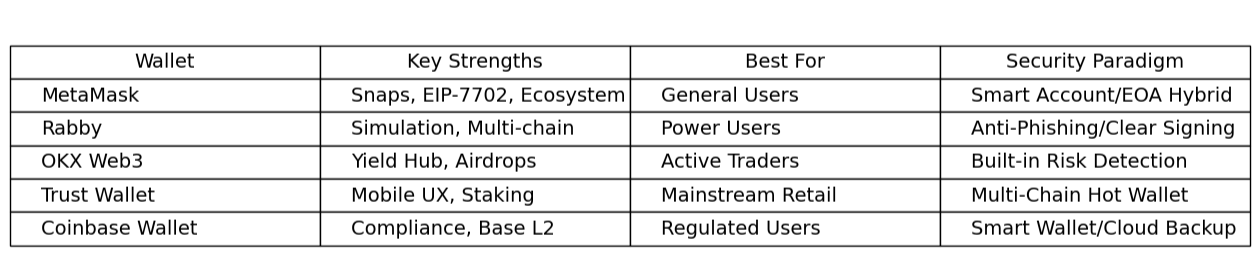
MetaMask remains the most widely utilized wallet in 2026, having successfully transitioned from a simple browser extension to a modular “Web3 Hub”. Its primary competitive advantage is “MetaMask Snaps,” a framework that allows third-party developers to inject new functionality—such as Bitcoin support or advanced phishing detection—into the MetaMask interface.
By early 2026, MetaMask has fully integrated “Gasless Swaps,” utilizing the token being swapped to cover the network fee, thereby removing the need for an ETH balance for active traders. The “MetaMask Smart Account” (powered by EIP-7702) has become the default for its 2026 user base, enabling atomic batching and custom security policies such as daily spend limits and whitelisted addresses. Despite its dominance, the interface is often criticized by power users for its historical EVM-centricity, though its 2026 updates have significantly improved its cross-chain UX through the integration of aggregators that find the most efficient liquidity routes across Layer-2s.
Rabby Wallet: The Standard for Transaction Transparency
Rabby Wallet has ascended to the top of the “expert” tier in 2026, particularly for users focused on intensive DeFi and multi-chain operations. Developed by the DeBank team, Rabby’s hallmark feature is its pre-sign simulation. Before a user approves any transaction, Rabby simulates the outcome on-chain and presents a human-readable summary of the balance changes and potential security risks.
Rabby is specifically designed to handle the complexity of the 2026 multi-chain environment, where users frequently move assets between Ethereum, Arbitrum, Base, and various ZK-rollups. Its automatic network switching and support for over 20 hardware devices make it the most versatile interface for those who prioritize security and transparency over brand recognition. For the 2026 DeFi power user, Rabby’s ability to detect “honeypot” contracts and warn about “infinite approvals” is considered a non-negotiable safety feature.
Trust Wallet and the OKX Web3 Ecosystem
Trust Wallet continues to capture the mainstream retail market, with over 200 million users by 2026. Its integration with the Binance ecosystem provides a smooth fiat-to-crypto ramp, while its 2026 focus on “Barz” smart accounts (using Etherspot’s Skandha bundlers) has brought account abstraction to the mobile masses. Trust Wallet excels in its multi-chain breadth, supporting 70+ blockchains and providing a simplified staking interface that allows users to earn yield on ETH, SOL, and DOT with a single tap.
The OKX Web3 Wallet has positioned itself as the “Super App” for the 2026 cycle. It is more than a wallet; it is an aggregation layer that includes a built-in DEX, an NFT marketplace, and a “yield aggregator” that automatically moves stablecoins to the highest-performing audited protocols. For airdrop hunters and early-stage protocol explorers, OKX’s “Cryptopedia” feature provides curated access to new networks, often with built-in gas sponsorship for first-time interactions.
Hardware Wallets: The Ultimate Fortress for 2026
Despite the convenience of software wallets, the “Hardware Boom” of 2025 and 2026 has seen cold wallet ownership rise by 34% annually. In an era where “Chinese money laundering networks” and “sophisticated North Korean hackers” dominate the illicit on-chain landscape, the physical isolation of private keys remains the only defense against remote exploits.
OneKey and the Open-Source Renaissance
OneKey has disrupted the hardware market in 2026 by championing a fully open-source philosophy. The OneKey Pro model is the first to feature four EAL 6+ secure elements, providing bank-grade protection for private keys. Unlike legacy competitors, OneKey’s hardware and software are entirely transparent, allowing the global security community to audit the code for backdoors.
A standout feature of the 2026 OneKey ecosystem is “SignGuard.” This technology provides a dual-parsing mechanism where both the OneKey App and the hardware device independently verify the transaction data. This prevents a compromised mobile phone from tricking the user into signing a malicious transaction, as the hardware device will display a clear warning if the signature request does not match the simulated outcome.
Ledger and Trezor: The Established Standards
Ledger remains the market leader in terms of volume, with the Ledger Stax and Ledger Flex models defining the high-end hardware experience. These devices utilize curved E-Ink displays to show full transaction details, mitigating the risk of “blind signing” that plagued earlier models. Ledger Live has evolved into a comprehensive DeFi interface, allowing users to participate in liquid staking and restaking via EigenLayer without moving assets to a hot wallet.
Trezor, meanwhile, has doubled down on its commitment to maximalist security. The Trezor Safe 5, released in late 2025, excludes Bluetooth and wireless connectivity to minimize the electronic attack surface. Its use of “Shamir Backup” allows users to split their recovery phrase into multiple shares, requiring a threshold (e.g., 3 out of 5) to recover the wallet. This has become the preferred solution for high-net-worth individuals who want to distribute their recovery risk across multiple geographic locations.
Tangem and the NFC Revolution
Tangem has pioneered a unique “Seedless” hardware category in 2026. Using NFC-enabled smart cards or rings, Tangem stores private keys in a secure element that is impossible to extract. Users sign transactions by tapping the card to their smartphone. The 2026 Tangem setup typically involves a “3-card pack,” where each card acts as a backup for the others, eliminating the need for a physical seed phrase written on paper. This design has proven particularly popular for “daily payment” use cases, where users want cold storage security with the form factor of a credit card.
Security Trends and Risk Mitigation in the 2026 DeFi Ecosystem
The security landscape of 2026 is defined by a paradox: while the underlying blockchain protocols are more secure than ever, the human-facing interface remains vulnerable. Hacken reports that over 3.1 billion was lost in the first half of 2025 alone, with the majority of losses stemming from “wallet compromises and phishing” rather than protocol exploits.
The Professionalization of Phishing
In 2026, phishing has moved beyond simple fake websites. Attackers now use “malicious approvals” where a user is tricked into signing a transaction that grants a contract unlimited access to their tokens (e.g., approve(address spender, uint256 amount) where amount is 2^{256}-1). To combat this, modern wallets like FoxWallet and OneKey integrate real-time risk scores from GoPlus and Blockaid. These services scan contracts for “rug pull” logic or suspicious transfer patterns before the user signs.
Multi-Party Computation (MPC) and the End of Single-Point Failure
MPC wallets, led by Zengo, have become a dominant force for users who want to avoid the responsibility of a seed phrase. By splitting the private key into two or more “mathematical secret shares”—one on the user’s phone, one on the provider’s server, and one in a recovery cloud—MPC ensures that neither party can move funds independently. In 2026, Zengo’s “ClearSign” firewall acts as a Web3 proxy, intercepting and analyzing every contract call for potential threats.
MEV Protection at the Wallet Level
Maximal Extractable Value (MEV) has become a multi-billion dollar “tax” on DeFi users. In 2026, most top-tier wallets (MetaMask, Rabby, Ledger) offer built-in MEV protection. By routing transactions through “Private RPCs” such as Flashbots or MEV-Share, these wallets ensure that users are not “sandwiched” by bots that manipulate the price of an asset between the time a transaction is submitted and the time it is mined. This is no longer an optional feature for power users but a default setting for any wallet aiming to provide a competitive DeFi experience.
Staking, Restaking, and the Yield Economy in 2026
The Ethereum network’s transition to a Proof-of-Stake (PoS) consensus has created a massive yield-bearing economy. In 2026, wallets have become the primary management interface for this capital, with a specific focus on “Liquid Staking” and “Restaking”.
Liquid Staking Tokens (LSTs)
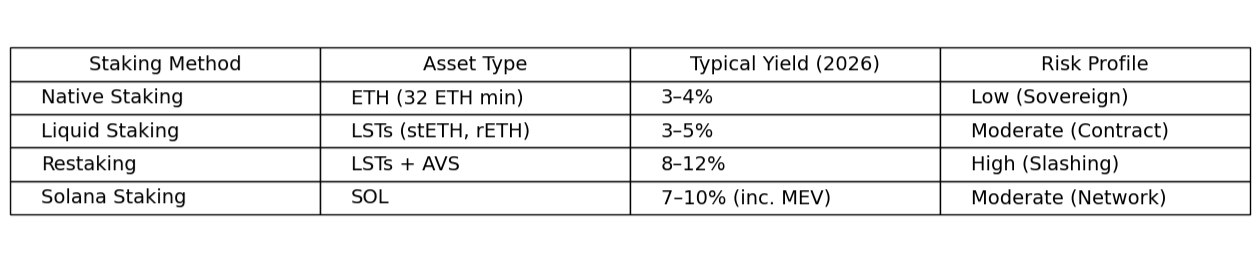
Liquid staking allows users to stake their ETH and receive a derivative token (like Lido’s stETH or Rocket Pool’s rETH) that can be used in other DeFi protocols. In 2026, LSTs are the most common form of collateral in lending markets. Wallets like Rainbow and Coinbase Wallet provide “one-click” staking, where the wallet handles the deposit into the protocol and the management of the resulting LST.
The Rise of EigenLayer and Restaking
Restaking has emerged as the “influential innovation” of the 2026 cycle. Protocols like EigenLayer allow users to take their already-staked ETH (or LSTs) and “restake” them to secure additional services, known as Actively Validated Services (AVSs). This creates a “pooled security” model where ETH acts as a universal trust layer.
For the 2026 wallet user, restaking offers an additional layer of yield (often 8-12% combined) but introduces significant slashing risks. Wallets like Ledger Enterprise and Anchorage Digital have integrated native restaking for institutional clients, allowing them to manage their withdrawal credentials and monitor their AVS exposure from a single, audited dashboard.
Identity, Governance, and Social Integration
In 2026, an Ethereum wallet is no longer just a financial account; it is a digital identity. This is facilitated by the Ethereum Name Service (ENS) and social protocols like Lens and Farcaster.
ENSv2 and the “Identity Anchor”
ENS has evolved beyond simple “.eth” names. The 2026 launch of ENSv2 has enabled Layer-2 native names, drastically reducing registration costs and allowing users to store multiple crypto addresses, social metadata, and content hashes within their name record. Wallets like OneKey and Rainbow now feature “Address Resolution” where they automatically display the ENS name of the recipient, preventing “address replacement” attacks where a hacker substitutes a similar-looking address into the user’s clipboard.
DAO Voting and Wallet-Native Governance
Participation in DAO governance has moved from “clunky web interfaces” directly into the wallet. Modern wallets integrate with governance aggregators (like Tally or Snapshot), allowing users to view active proposals and cast votes without leaving their wallet app. This “wallet-native governance” has seen voter turnout in major DAOs increase from <10% to over 30% in 2026, as users can now delegate their voting power or participate in “fluid democracy” with a single signature.
Geographic Variations and Regulatory Compliance
The 2026 wallet experience is significantly shaped by local regulations, particularly in major hubs like India and the European Union.
The Indian Regulatory Landscape: Budget 2025 and 2026
India has adopted one of the world’s most aggressive tax regimes for digital assets. As of February 1, 2025, any undisclosed crypto holdings detected during a tax search are subject to a 60% tax rate, including surcharges and penalties. For the 2026 DeFi user in India, the flat 30% tax on gains and 1% TDS (Tax Deducted at Source) on every transaction has made “Compliance-Heavy” wallets the norm.
Every DeFi trade in 2026 leaves a “digital trail straight to the tax department”. Consequently, wallets that integrate with Indian tax platforms (like CoinTracker or KoinX) are highly favored. The government’s move to treat crypto as “undisclosed income” on par with unexplained cash has transformed the Indian DeFi market from a speculative playground into a rigorously tracked financial sector.
Business and Institutional Wallets
For businesses, non-custodial wallets are no longer just for holding assets; they are for “operational simplicity”. Monetum leads this segment by combining an on-chain ETH wallet with a SEPA Euro account and an integrated business IBAN. This allows global companies to convert crypto to Euro and off-ramp directly to the SEPA network, providing a “rare capability” that bridges the gap between decentralized finance and traditional corporate treasury.
The Future of the Wallet: Embedded and Invisible
As 2026 draws to a close, the trend is moving toward “Embedded Wallets.” For mass-market applications like games and social media, the user may not even know they have a wallet.
The Sequence and Argent Model
Protocols like Sequence utilize “Meta Transactions” to deliver a gasless experience where the developer pays for the user’s interaction. In this model, the wallet is an “invisible” infrastructure layer that lives inside the app. If a user wants to “graduate” to full control, they can export their private key or link the embedded account to a primary wallet like MetaMask or Rabby. This “progressive decentralization” of the user experience is the primary driver of “mass retention” in the 2026 cycle.
The Impact of EIP-7702 on User Retention
EIP-7702 has fundamentally changed the “retention” story for 2026. Because users can now “upgrade” their old accounts to have smart features (like recovery and batching), they are less likely to abandon the ecosystem due to complexity. The 2026 flow is described as “boring in a good way,” where the user thinks about the application rather than the underlying signature mechanics.
Conclusions and Strategic Recommendations for 2026
The Ethereum DeFi wallet market in 2026 is a sophisticated ecosystem where security and usability have finally reached a sustainable equilibrium. For the professional peer or investor navigating this space, the following strategic insights are paramount:
The transition from EOAs to Smart Contract Accounts is the most significant architectural shift in the history of the network. Any wallet that does not support ERC-4337 or EIP-7702 is considered a legacy product and represents a significant risk to user retention and security.
Transaction simulation (as seen in Rabby) and hardware-level parsing (as seen in OneKey) are the only effective defenses against the professionalized phishing industry of 2026. “Blind signing” is now a catastrophic failure of security protocol.
The “Cold/Hot Hybrid” model is the gold standard. Users should utilize an MPC or Smart Account (like Argent or Zengo) for daily high-frequency DeFi, while anchoring their primary wealth in an open-source hardware device (like OneKey or Trezor).
The wallet has become the “Public, Verifiable Resume” of the decentralized economy. Managing digital reputation through ENSv2 and governance participation is as critical as managing financial assets for users seeking to participate in the “Next Generation” of credit and identity-based DeFi.
In summary, the “Best” DeFi wallet of 2026 is not a single product, but a strategic stack. For the retail enthusiast, MetaMask with Ledger integration or Trust Wallet provides the most comprehensive access. For the power user, Rabby Wallet paired with OneKey Pro offers the highest level of transparency and risk mitigation. For the institutional entity, Safe and Ledger Enterprise provide the necessary governance and compliance hooks to manage capital at scale. The 2026 ecosystem is characterized by this diversification, ensuring that as Ethereum grows to its next billion users, the infrastructure is ready to protect their assets with the same rigor as traditional finance, but with the autonomy of the blockchain.